

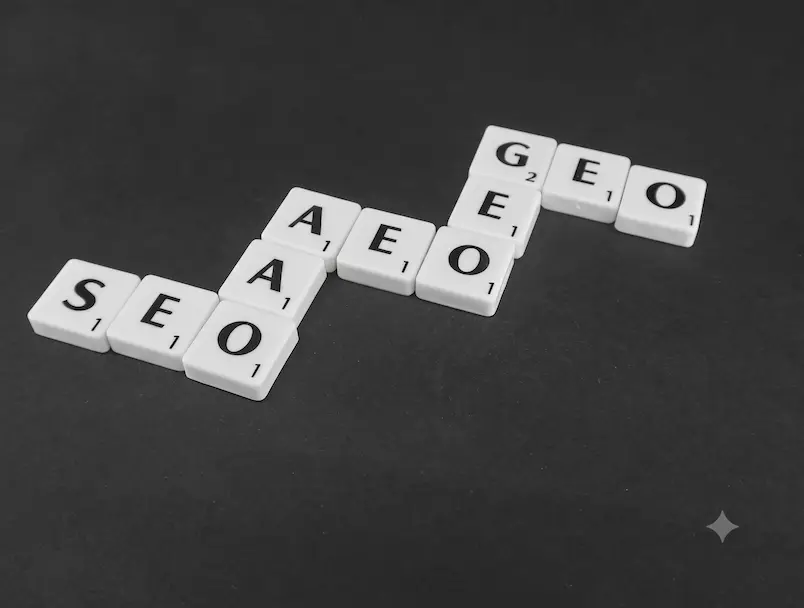
What Are the Main Differences Between AEO and SEO in Online Marketing?
Answer Engine Optimization (AEO) structures content so that AI systems like ChatGPT, Perplexity, Gemini, and Google AI Overviews can extract and cite it directly, while Search Engine Optimization (SEO) structures content so that traditional search engines can rank it on a results page. SEO measures success through keyword rankings and organic traffic. AEO measures success through citations and mentions inside AI-generated answers.
Marketing teams face a real problem: traditional search rankings no longer guarantee visibility once an AI system answers the question before a user ever clicks a link. At Gallea Ai, our team has spent more than 15 years combining hands-on AI strategy work with SMB clients across financial services, food and beverage, professional services, and e-commerce. We have seen firsthand how a business can rank on page one and still be invisible inside ChatGPT or an AI Overview.
Quick-Reference Facts
- AEO optimizes content for AI-generated answers, voice search, and assistant responses, while SEO optimizes pages to rank inside traditional search engine results pages.
- Structured data and schema markup are required for AEO because AI models rely on machine-readable signals to understand and extract content.
- Combining AEO and SEO increases visibility across both zero-click AI surfaces and conventional organic search results.
- Website, blog, and SEO channels remain the top ROI-driving marketing channels in 2026, even as AI search adoption grows, according to HubSpot's State of Marketing report.
- Nearly 30% of marketers report declining search traffic as consumers shift to AI tools, making AEO a defensive necessity, not an optional add-on.
What Is the Main Difference Between Optimizing for Traditional Search and Optimizing for AI Answers?
Traditional SEO optimizes a web page to earn a ranking position on a search engine results page. AEO optimizes the same content to be selected, extracted, and cited as the direct answer inside an AI-generated response.
The distinction sounds subtle, but the mechanics are different. Traditional search engines crawl, index, and rank full pages, then let the user click through to evaluate the content themselves. Answer engines parse content into discrete facts, quote or paraphrase the clearest passage, and often never send the user to the source page at all.
This changes what "winning" looks like. A page can hold a top-three ranking in Google's organic results and still receive zero citations inside an AI Overview, because the AI system chose a different, more extractable passage from a competitor. In our audits, we consistently find that clients ranking well in traditional search are frequently absent from AI-generated answers for the same query, simply because their content is not structured for extraction.
- SEO focus: keyword relevance, backlinks, domain authority, page speed, technical SEO health
- AEO focus: direct-answer clarity, structured data, entity relationships, conversational phrasing
- Shared foundation: both depend on crawlability, site structure, and genuine topical authority
How Does AEO Compare to SEO in Driving Website Traffic?
SEO drives clicks to a website. AEO drives citations inside an answer, which often means fewer clicks but higher-intent visitors who already trust the brand before arriving.
SEO captures over 40% of a business's revenue-driving traffic through organic channels, and website, blog, and SEO remain the top ROI channel that marketers report in 2026, according to HubSpot's State of Marketing report. That statistic alone explains why abandoning traditional SEO in favour of AEO would be a mistake. Organic traffic from ranked pages still fills the funnel that AEO citations cannot replace on their own.
AEO changes the shape of that funnel rather than replacing it. A user who sees a brand cited inside a Perplexity answer or a Google AI Overview arrives at the website later in the buying journey, already informed and pre-qualified. This is exactly what happened when we worked with a financial services client competing against ten established loan comparison platforms with decades of domain authority and cost-per-click rates above fifty dollars. Our team combined content architecture, structured data, and entity authority building, the same methodology behind Gallea AEO, and the client saw a 581% organic traffic increase, a 961% jump in first-page impressions, 78 first-page keyword rankings, and $90,665 in attributed revenue within five months.
| Metric | Traditional SEO Alone | AEO Layered on SEO |
| Traffic source | Organic search clicks | AI citations plus organic clicks |
| User intent stage | Mixed funnel stages | Higher-intent, later-stage visitors |
| Visibility surface | Search engine results pages | ChatGPT, Perplexity, Gemini, AI Overviews, voice assistants |
| Click behavior | Click-through required | Often zero-click, brand still gains exposure |
How Do Content Strategies Need to Adapt for Generative AI Search Results?
Content built for generative AI search must lead with a direct, extractable answer in the first sentences, then support that answer with structured detail an AI model can parse cleanly. Content built purely for traditional SEO can bury the answer under a long narrative introduction, because a human reader will scroll to find it.
AI-generated content favours immediate, clear answers over long-form buildup. That means every section should open with a plain factual statement before expanding into supporting detail, examples, or nuance. Generative engine optimization techniques, including conversational phrasing that mirrors how people actually ask questions out loud, help content match the query patterns AI systems process.
Regular content updates also strengthen AEO effectiveness, since AI models tend to favour freshness signals when choosing which source to cite. Our internal review of client accounts, detailed in Gallea Ai's guide to building an AEO content strategy, found that pages updated on a quarterly cadence retained AI citations at a noticeably higher rate than pages left untouched for a year or more.
What Are the Best Practices for Structuring Content to Be Picked Up by Answer Engines?
Content gets picked up by answer engines when it uses structured data, concise direct-answer formatting, and clear entity relationships that machines can parse without ambiguity. Loose prose without hierarchy or markup rarely survives the extraction process AI systems.
FAQ schema, question-based headings, and bullet-point breakdowns all improve the odds of citation because they mirror how AI systems chunk content for retrieval. Schema markup, implemented through JSON-LD, tells an AI crawler exactly what an entity is, how it relates to other entities, and which facts belong together, functioning much like a labelled index card instead of a wall of text.
- Answer the question first. Open every section with a 40 to 60 word direct answer before adding context, exactly the format that wins featured snippets, according to Semrush's guidance on SERP features.
- Add FAQ schema to question-based content. This gives AI systems structured, pre-formatted answers, improving AEO visibility.
- Use conversational, question-style headings. Match how users type into ChatGPT or ask a voice assistant.
- Bold or list key facts. Bullet points and bolded entities help NLP parsers isolate discrete, quotable facts.
- Keep technical SEO healthy. Core Web Vitals, page speed, and clean site structure still determine whether a crawler reaches the content at all.
Gallea Ai's own breakdown of schema markup for AEO walks through exactly which JSON-LD types matter most for AI extraction, and it pairs naturally with the featured snippet and Position Zero guide for teams building both strategies at once.
Which Companies Specialize More in AEO Over SEO Strategies?
Some digital marketing firms have shifted their primary focus toward AEO because their client base depends heavily on being cited inside AI answers rather than ranked on a results page, particularly in categories where AI Overviews now dominate the query. That shift usually shows up in three specific practices: structured data implementation, entity authority building, and AI citation monitoring, rather than backlink acquisition alone.
Gallea Ai operates as an AEO-first firm within a broader SMB strategy practice, and our team's core service positions businesses to be cited across ChatGPT, Perplexity, Google AI Overviews, and voice assistants. This case study directly illustrates that methodology: an 18-person digital marketing agency with strong traditional SEO rankings had become invisible inside Google AI Overview, ChatGPT, and Perplexity for its own core service category. After Gallea Ai ran a full AI Visibility Audit and rebuilt the agency's content around entity relationships and structured markup, the agency achieved featured placement in Google AI Overview and a 40% increase in qualified inbound leads.
A useful diagnostic when evaluating any firm's real specialization is whether it can show citation-tracking data, not just ranking reports. Gallea Ai's comparison of AEO agencies and its guide to choosing the best AEO provider both walk through the specific criteria that separate a genuine AEO specialist from a traditional SEO firm rebranding its service list.
What Tools Are Best for Optimizing Content for AEO Versus SEO?
SEO tools focus on keyword research, backlink tracking, and rank monitoring, while AEO tools focus on citation tracking, structured data validation, and AI visibility monitoring across multiple answer engines. The two toolsets overlap but answer fundamentally different questions.
Google Search Console remains essential for traditional SEO because it reports impressions, click-through rate, and indexing status in classic search. Ahrefs and Semrush extend this with backlink analysis, keyword research, and competitor rank tracking. None of these tools, on their own, tell a business whether ChatGPT or Perplexity is citing its content.
- Traditional SEO stack: Google Search Console, Ahrefs, Semrush, Moz for keyword rankings, backlinks, and technical SEO audits
- AEO monitoring stack: dedicated AI citation trackers that scan ChatGPT, Perplexity, Gemini, and AI Overviews for brand mentions
- Structured data validators: schema testing tools that confirm JSON-LD implementation reads correctly before an AI crawler ever touches it
- Combined approach: Gallea AEO, which layers citation monitoring and structured data audits on top of standard technical SEO reporting
Gallea Ai's comparison of the leading LLM optimization tools and its dedicated AI citation tracking guide both cover the specific platforms worth evaluating for teams building an AI share-of-voice practice in 2026.
Compare the ROI of Investing in Traditional Search Rankings Versus Answer Engine Prominence
Traditional search rankings deliver measurable, compounding organic traffic over time, while answer engine prominence delivers fewer but higher-intent visitors and protects a brand from disappearing entirely as AI-mediated search adoption grows. Neither investment replaces the other; each protects against a different risk.
Roughly 30% of marketers already report declining search traffic tied to the shift toward AI tools, signaling that ROI calculations based purely on legacy click-through metrics will understate real business risk. A brand that only tracks organic sessions may miss that its category's buyers have moved a stage earlier in the journey, into an AI chat interface that never generates a click.
Gallea Ai's food and beverage client illustrates the ROI case for AEO specifically. A single-location restaurant business optimized for voice search, a channel producing zero foot traffic before the engagement, targeting roughly half of households with smart speakers. The result: a 20% increase in walk-in customers, with 58% of new customers attributing discovery to voice search and 15-plus first-page voice query rankings achieved. That revenue impact came from a channel traditional SEO reporting would never have captured, because no clicks, sessions, or keyword rankings would have shown up in a standard analytics dashboard.
Can AEO Improve Search Rankings Better Than Traditional SEO Methods?
AEO does not replace traditional SEO ranking factors, but structured, direct-answer content built for AEO often improves traditional rankings as a side effect, because search engines increasingly reward the same clarity signals AI systems require. The two disciplines share more infrastructure than most marketers assume.
Google's ranking systems and its AI Overview feature draw from overlapping signals: content depth, entity recognition, structured data, and user intent match. When a page earns an FAQ schema markup and a tightly answered question format for AEO purposes, it frequently becomes a stronger featured snippet candidate as well, since both formats reward the same 40 to 60-word direct-answer structure.
In our experience working with SMB clients, the sites gaining the fastest traditional ranking improvements are usually the ones that adopted AEO-style structuring first, not the reverse. Gallea Ai's guide comparing AEO against traditional SEO priorities breaks down exactly which sequencing works best depending on a business's current ranking baseline.
AEO vs SEO Differences Explained
The clearest way to separate AEO vs SEO is by output: SEO earns a ranking position, AEO earns a citation within an AI-generated answer, and a modern digital marketing strategy needs both to work together.
| Dimension | SEO | AEO |
| Primary goal | Rank in search engine results pages | Get cited in AI-generated answers |
| Content format | Long-form, keyword-optimized pages | Concise, direct-answer, FAQ-style content |
| Key technical lever | Backlinks, technical SEO, page speed | Structured data, schema markup, entity clarity |
| Success metric | Keyword rankings, organic traffic | Citation frequency, AI mentions, share of voice |
| Platforms targeted | Google, Bing traditional results | ChatGPT, Perplexity, Gemini, Google AI Overviews, voice assistants |
| Relationship to the other | Foundation AEO builds on | Extension that captures AI-mediated demand |
AEO and SEO strategies can run simultaneously without conflict, and combining both increases visibility across the full AI ecosystem rather than forcing a choice between them. From what we've seen across financial services and food and beverage clients, businesses that treat AEO as a bolt-on rather than an integrated layer of their existing SEO strategy leave measurable revenue on the table.
What Should You Do Next About AEO vs SEO?
Start by auditing whether your highest-value pages currently appear inside AI-generated answers for your core queries, not just where they rank on a traditional search engine results page. From there, prioritize structured data and schema markup on the pages already ranking well, since those are the fastest path to AEO citations. Layer in a consistent content update cadence and a brand voice system so every new page publishes AEO-ready from day one, a workflow Gallea Brand Voice Pro was built to support alongside Gallea AiOS for converting the resulting traffic once it arrives.
To find your highest-ROI AEO and SEO moves, book a free 30-minute consultation with Gallea Ai, no obligation, no sales pitch. Our team will assess your AI readiness and identify the 1-2 highest-ROI moves for your business.