

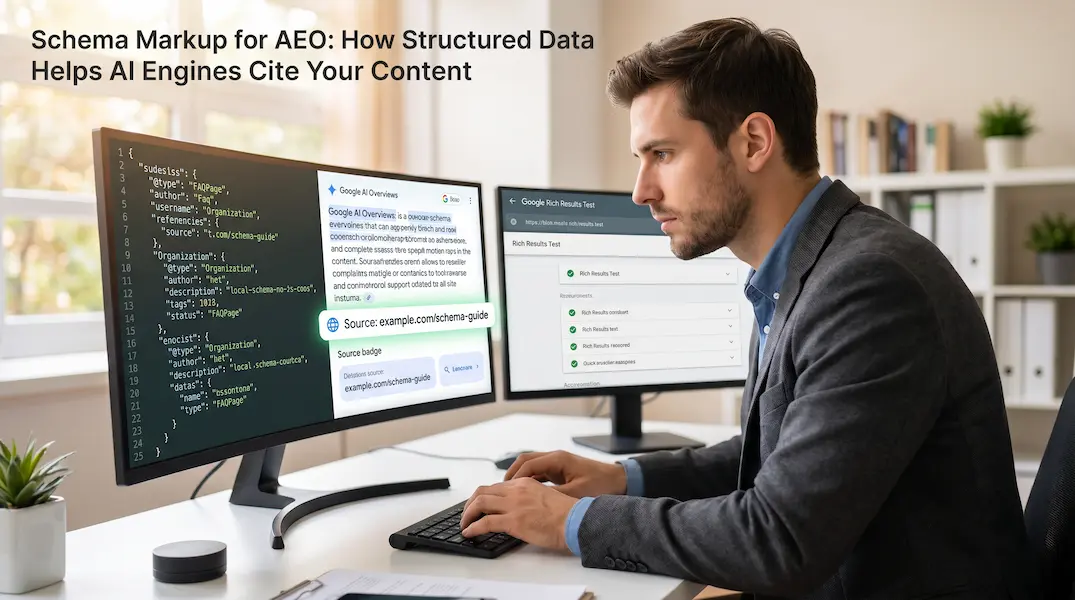
Schema Markup for AEO: How Structured Data Helps AI Engines Cite Your Content
Schema markup for AEO is the JSON-LD structured data that labels a page's entities, answers, authors, and relationships so AI answer engines, such as ChatGPT, Perplexity, Google AI Overviews, and Gemini, can extract and cite the content with confidence. Schema does not cause citations on its own. It feeds the Knowledge Graph and rich-result pipelines that AI platforms rely on for verification.
At Gallea Ai, our team deploys template-level JSON-LD for every client engagement because one-off page-level schema rarely scales. With 15+ years of combined AI strategy experience and as a credentialed IBM Silver Business Partner, we've seen schema gaps quietly block otherwise strong content from ever being cited.
Key Takeaways
- Pages with comprehensive schema markup are 36% more likely to appear in AI-generated citations, according to research cataloged by WPRiders and referenced in ZipTie's FAQ schema analysis.
- FAQPage schema pages earn up to 3.2x higher Google AI Overview inclusion rates compared to pages without it, per CapConvert's 2026 schema-for-LLM analysis and Averi.ai's FAQ optimization guide.
- Schema markup can lead to up to a 35% CTR improvement with rich results, according to Averi.ai's schema implementation guide.
- 89% of Perplexity citations correlate with valid schema on the source page, per the AISEO 650-site analysis summarized by ZipTie.
- 76.4% of ChatGPT's top-cited pages were updated within the last 30 days, making schema dateModified and freshness a core citation signal, per Averi.ai's FAQ optimization data.
Why Schema Markup Is a Foundation of AEO Success
Schema markup is structured data added to HTML in JSON-LD format to explicitly label a page's entities, content type, and relationships. Answer Engine Optimization (AEO) depends on schema because AI systems need machine-readable signals to extract, verify, and cite information accurately.
Schema reduces ambiguity. When a page specifies that "Q1 revenue" is a number, the publisher is the Organization, and the author has credentials, AI systems treat those facts as structured, verifiable claims. Without a schema, the same content reads as undifferentiated text.
How Structured Data Enhances AI Search Capabilities
Structured data enhances AI search capabilities in three concrete ways:
- Entity disambiguation. Schema sameAs properties map brands, people, and products to the Google Knowledge Graph, Wikidata, and Wikipedia, so AI systems know exactly which entity a page references.
- Fact extraction. Properties such as price, availability, openingHours, author, and datePublished provide AI systems with machine-readable facts that reduce the risk of hallucinations.
- Structure interpretation. FAQPage, HowTo, and Article schema signal content type explicitly, matching how AI systems parse query intent.
AirOps research cited by Golaco Content found that sequential headings paired with rich schema correlate with 2.8x higher citation rates, and BrightEdge data in the same analysis showed a 44% increase in AI search citations for sites using structured data with FAQ content blocks.
Importance of Schema Markup and Structured Data for AEO in 2026
Schema sits at the junction of traditional SEO-rich results and AI citations. In 2026, three shifts make it non-negotiable:
- Google AI Overviews appear in 48% of queries, per Averi.ai's 2026 playbook, and their inclusion correlates closely with schema coverage.
- LLMs use knowledge graphs during retrieval. Schema serves as the factual source layer that helps models disambiguate and confidently cite a brand.
- Schema dateModified, author, and publisher properties anchor E-E-A-T signals that AI systems weigh heavily during citation selection.
In our audits of SMBs across financial services, food & beverage, and professional services, we consistently find strong content paired with incomplete schema coverage. The gap typically sits at the template layer, which is where we solve it.
Which Schema Types Matter Most for AI Answer Extraction
Not every schema type matters equally. The types that drive AI citation align with how AI systems ingest and structure answers.
| Schema Type | What It Does | When to Use | Impact on AI Citation |
| Organization | Establishes brand as a disambiguated Knowledge Graph entity | Homepage, About page, site-wide via @id | Foundational — reinforces entity authority across every AI surface |
| Article/BlogPosting/NewsArticle | Marks long-form content with author, datePublished, dateModified | Blog posts, news, editorial content | Anchors provenance, recency, and author E-E-A-T |
| FAQPage | Labels question-answer pairs in the exact format LLMs parse | Pages with genuine FAQ content | Up to 3.2x higher AI Overview inclusion rate |
| HowTo | Marks step-by-step instructions | Tutorials, recipes, implementation guides | Strong extraction for procedural queries |
| Speakable (BETA) | Flags sections best suited for text-to-speech | News content, concise summaries | Voice assistant eligibility per Google Search Central guidance |
| Person | Ties authors to credentials via sameAs | Author bylines, team pages | Signals expertise to AI algorithms |
| LocalBusiness | Declares NAP, hours, and location | Local business pages | Critical for "near me" and voice queries |
| Product | Declares price, availability, SKU, reviews | Product pages | Rich results + AI product comparison citations |
| VideoObject | Declares video content, transcript, and thumbnail | Video-anchored pages | Expands multimodal AI citation potential |
| Event | Declares event name, date, location, and organizer | Event pages, webinars | Event-specific AI Overview and Knowledge Panel placement |
FAQ, HowTo, and Speakable Schema: The AEO Essentials
Three schema types deliver outsized AEO returns:
- FAQPage schema earns the highest citation multipliers. Research from Averi.ai's FAQ optimization guide documents 28% higher citation rates with properly structured FAQPage structured data, and CapConvert's 2026 analysis reports 3.2x higher inclusion in Google AI Overview.
- The HowTo schema captures procedural queries in which AI systems output numbered-step answers. Use it only where pages genuinely provide sequential instructions.
- Speakable schema flags text-to-speech-ready sections for Google Assistant and voice surfaces. Per Google's Speakable guidance, target 20–30 seconds of content per marked section, roughly two to three sentences.
How to Implement Schema Markup for AEO Step by Step
Implementation follows a disciplined sequence. Skip the audit and validation steps, and the schema fails silently. Pages look fine, but they never earn rich results or AI citations.
- Audit the schema coverage across all template types. Our team runs a site-wide crawl, mapping current schema against the target stack (Article, FAQPage, Organization, Person, LocalBusiness, where applicable).
- Select the schema types that match each template's content. Pages without genuine FAQ content should not carry the FAQPage schema; the markup must match the visible content.
- Write JSON-LD blocks following Schema.org specifications, with all required and recommended properties populated.
- Deploy schema at the template layer so it scales with every new page rather than requiring per-page implementation. Our team operationalizes this through Gallea AiOS.
- Link entities to the Knowledge Graph via sameAs properties pointing to Wikipedia, Wikidata, LinkedIn, and authoritative category profiles.
- Anchor author E-E-A-T by binding every Article to a Person schema entry with credentials, and ensuring author pages use the sameAs pattern.
- Validate using Google's Rich Results Test and the Schema Markup Validator — both are required. We cover the full validation workflow in the next section.
- Monitor via Google Search Console's structured data reports and AI citation panels. Treat validation as a continuous process, not a launch milestone.
JSON-LD Implementation Guide for Answer-Optimized Pages
JSON-LD is the preferred format for schema markup because it separates structured data from HTML, loads asynchronously, and is easiest for both Google and AI systems to parse.
Core implementation principles:
- Place JSON-LD inside a <script type="application/ld+json"> tag, typically in the <head> or just before </body>.
- Use @id references to connect schema objects (Organization → WebSite → WebPage → Article → Author) so AI systems see a coherent entity graph.
- Populate every required property plus Google's recommended properties (for example, Article requires headline, author, datePublished; image, dateModified, and publisher are recommended), per Google's structured data documentation.
- Mirror the visible content exactly. FAQPage Q&A pairs must appear on the page; prices in the Product schema must match displayed prices.
- Use the most specific type available. BlogPosting beats Article for a blog; MedicalBusiness beats LocalBusiness for a clinic.
Mini Case Study: Financial Services SMB
- Goal: Help a financial services SMB earn citations inside AI Overviews and Perplexity for high-intent advisory queries.
- Challenge: The client had strong content and backlinks but zero AI citation presence; schema coverage was limited to basic WebSite markup, leaving every article, FAQ, and author profile invisible to AI extraction pipelines.
- What We Did: Our team deployed FAQPage and Article JSON-LD site-wide through Gallea AiOS, built a Person schema with sameAs links for every advisor, added an Organization schema with IBM Silver Business Partner references, and validated the full stack using the Rich Results Test and Schema Markup Validator.
- Result: +581% organic traffic, +961% first-page impressions, 78 first-page keyword rankings, and $90,665 attributed revenue in 5 months.
Common Schema Markup Mistakes That Block AI Citation
Schema fails silently when it's misconfigured; the page still renders, but neither rich results nor AI citations appear. The mistakes we see most often:
- Markup that contradicts visible content. The schema claiming FAQ content on the page does not trigger Google's structured data penalty and does not flag the page as unreliable to AI systems.
- Missing required properties. Article missing headline or datePublished fails validation completely.
- Generic schema type selection. Using Thing or a generic Article when a specific type (MedicalBusiness, NewsArticle, BlogPosting) exists incurs a contextual signal cost.
- Broken @id references that fragment the entity graph across pages, preventing AI systems from connecting Organization > Person > Article.
- Cosmetic dateModified updates. AI systems detect and ignore superficial date changes without meaningful content updates, per observations documented in Averi.ai's FAQ optimization research.
- One-off page-level schema that never scales past the homepage. Template-level deployment solves this.
- No validation step. Invalid JSON-LD produces zero rich results and zero AI citation lift.
How to Validate and Test AEO Schema Markup
Validate schema using Google's Rich Results Test for Google-supported types and the Schema Markup Validator for full Schema.org coverage. Use both, in sequence, on every template change.
The validation sequence per Google Search Central's structured data documentation:
- Run the Schema Markup Validator at validator.schema.org to confirm JSON-LD syntax and property structure.
- Run the Rich Results Test at search.google.com/test/rich-results to confirm eligibility for Google rich results.
- Monitor Google Search Console's structured data reports for site-wide errors, warnings, and valid-page counts.
- Spot-check individual pages monthly schema breaks when developers change templates, and silent failures are the rule, not the exception.
Tools and Services for Automating AEO Schema Implementation
Schema tooling falls into four categories. The right stack depends on site size, CMS, and team composition.
| Category | Primary Function | Best Fit |
| Validation tools | Syntax and Google eligibility checks (Rich Results Test, Schema Markup Validator) | Every implementation, every template change |
| CMS schema plugins | Automated schema injection inside WordPress, Shopify, HubSpot, Webflow | Small-to-mid sites with standardized templates |
| Enterprise schema platforms | Template-level schema, site-wide entity graph management | Mid-to-large sites with multiple content types |
| Custom JSON-LD pipelines | Programmatically generated schema tied to CMS data | Developer-led teams with unique data models |
| AEO service layer | Full-stack schema + content engineering + citation tracking | SMBs running a structured AEO program; Gallea AiOS deploys validated JSON-LD at the template layer |
In our experience with SMBs transitioning from plugin-based schema to template-level deployment, the citation-rate lift is measurable within 30–60 days. Consistency at the template layer prevents the silent failures that plague per-page implementations.
Frequently Asked Questions About Schema Markup for AEO
How do I implement schema markup for AEO?
Implement schema markup for AEO by auditing existing coverage, selecting the schema types that match each template (Article, FAQPage, Organization, Person, LocalBusiness), deploying JSON-LD at the template layer, validating through the Rich Results Test and Schema Markup Validator, and monitoring Google Search Console for silent failures. From what we've seen across financial services and food & beverage engagements, template-level deployment delivers roughly 3–5x the citation impact of per-page plugin schema.
What are the best practices for implementing schema markup for AI search?
The best practices for implementing schema markup for AI search are: deploy JSON-LD at the template layer, use the most specific schema type available, mirror visible content exactly, populate both required and recommended properties, link entities to the Knowledge Graph via sameAs properties, and validate every template through Google's Rich Results Test and the Schema Markup Validator. Skip any step, and the schema fails silently.
What schema markup types are most important for AEO?
The schema markup types most important for AEO are Organization, Article (or BlogPosting/NewsArticle), FAQPage, HowTo, Person, LocalBusiness, Product, and Speakable. FAQPage delivers the highest citation multiplier, up to 3.2x higher Google AI Overview inclusion, per CapConvert's 2026 analysis. Based on our work with SMBs, the fastest ROI sequence is Organization + Article + FAQPage, followed by Person and LocalBusiness.
How does structured data enhance AI search capabilities?
Structured data enhances AI search capabilities by providing entity disambiguation through sameAs properties, enabling fact extraction via typed properties like price and openingHours, and signaling content type so AI systems can match it to query intent. Pages with comprehensive schema are 36% more likely to appear in AI-generated citations, per WPRiders' schema-for-AI research.
What are the key benefits of using JSON-LD for AI-powered search?
The key benefits of using JSON-LD for AI-powered search are cleaner parsing (structured data lives separately from HTML), asynchronous loading (no impact on render performance), easier template-level deployment, Google's explicit preference over microdata and RDFa, and straightforward entity graph construction via @id references. JSON-LD is the preferred format for AI platforms because it separates machine-readable context from human-readable content.
The Path Forward for Schema Markup Implementation
Schema markup is the machine-readable layer that translates good content into citable content. Prioritize the three moves that compound fastest: template-level JSON-LD deployment, entity-graph connection through sameAs properties, and a disciplined validation workflow combining the Rich Results Test and Schema Markup Validator. In our experience across financial services, food & beverage, and professional services, SMBs that fix schema at the template layer capture AI citations within 30–60 days before category incumbents retool.
To audit your current schema coverage and deploy a template-level JSON-LD stack optimized for AI citation, book a free 30-minute consultation with Gallea Ai, no obligation, no sales pitch. Our team will assess your AI readiness and identify the 1–2 highest-ROI moves for your business.