

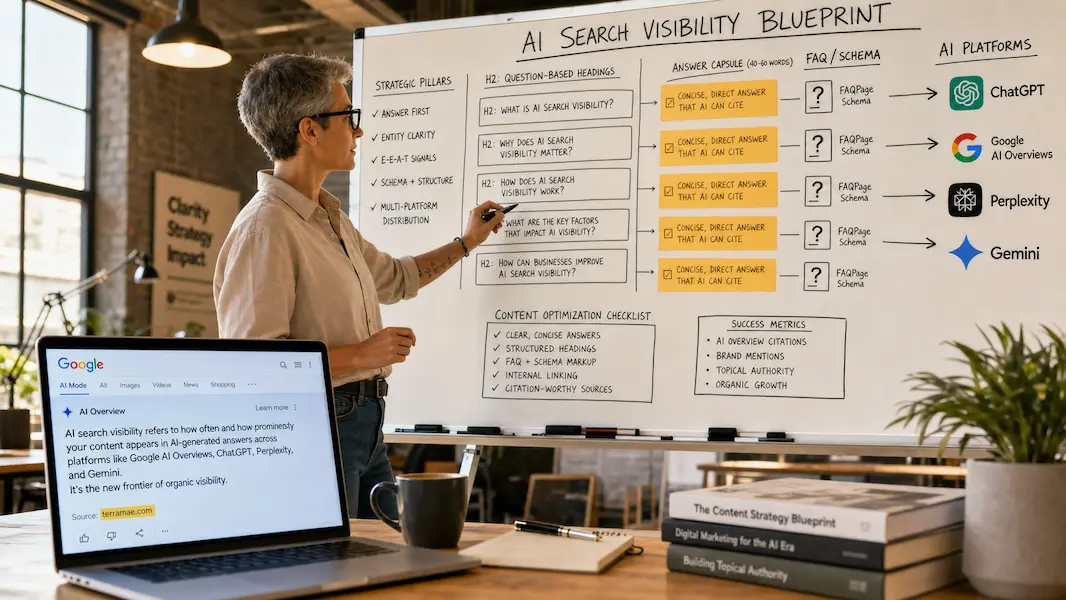
How to Build an AEO Content Strategy That Gets Your Business Cited by AI in 2026
An AEO content strategy is a structured plan for creating, formatting, and organizing content so that AI systems, including ChatGPT, Google AI Overviews, Perplexity, and voice assistants, can extract, cite, and present it as the direct answer to a user's question. It goes beyond traditional ranking signals to focus on answer readability, entity clarity, and structured information density.
Most businesses lose AI visibility not because their content is low quality, but because it is not structured in a way that AI engines can extract with confidence. At Gallea Ai, our team works with small and mid-size businesses across financial services, food and beverage, and professional services to close exactly that gap. With more than 15 years of combined AI and SEO strategy experience, we have seen firsthand that structured content, not just good writing, is what determines whether your business gets cited or ignored.
We had the opportunity to attend Google Search Central Live Canada 2026, where Google's own search and AI teams delivered a message our clients need to hear: the brands that win in AI search do not produce more content, they produce non-commodity content that answer engines can understand and reuse without extra work. That validation, straight from Google, shapes everything we share in this article.
Key Takeaways:
- AEO content strategy focuses on making content extractable by AI systems, not just rankable by search engines.
- Google Search Central Live Canada 2026 confirmed: good SEO is good GEO, the same fundamentals that drive organic rankings power AI citation eligibility.
- Pages with FAQPage schema markup are 3.2x more likely to appear in Google AI Overviews compared to pages without structured data.
- According to Ahrefs' 2026 study of 863K keywords, 38% of AI Overview citations now come from pages ranking in the top 10 organic results, meaning strong SEO authority remains a critical AEO foundation.
- Answer capsules, 40–80-word direct-answer blocks placed under question-based headings, are the single highest-impact content unit for AI extraction.
- Entity SEO and Knowledge Graph optimization deliver 40–60% improvements in AI search visibility and citation rates for businesses that implement them systematically.
What Makes an Effective AEO Content Strategy?
An effective AEO content strategy provides AI systems with clear, self-contained answers at every step of the content hierarchy, from the page title to individual paragraphs. It combines three elements: question-intent targeting, answer-first formatting, and machine-readable structure.
Traditional SEO focuses on driving traffic through keyword rankings and backlink authority. Answer engine optimization targets a different moment: the moment an AI system decides which source to quote. That decision happens at the passage level, not the page level. An AI engine scans your content, looking for a quotable block, a clean, self-contained answer it can lift and present without rewriting. If your page buries the answer under setup paragraphs, the engine moves on to the next candidate.
The most effective AEO content strategies share four structural commitments:
- Answer-first formatting: Every major section opens with a direct 1–2 sentence answer before any context or expansion.
- Question-based headings: H2 and H3 tags are phrased as natural user queries, the same phrases a person would type or speak to an AI assistant.
- High information density: AI models value extreme information density and immediate clarity. According to SE Ranking's analysis of 129,000 domains, pages with 19 or more statistics average 5.4 AI citations, compared with 2.8 for data-light content.
- E-E-A-T signals: Expertise, Experience, Authoritativeness, and Trustworthiness are critical components for enhancing brand visibility in AI-driven environments. Expert quotes, original case studies, and third-party citations all compound citation authority.
Attending Google Search Central Live Canada 2026 made one thing clear: Google's own AI search tips reinforce these same four principles. The event's "Tips for AI Search Success" slide placed non-commodity content above structured data and page experience, not beneath them. The full list presented on stage was: follow SEO fundamentals, make use of structured data, have a great page experience, and, more than anything else, produce unique, authentic, non-commodity content. Google's speaker added pointedly: "These align with traditional SEO success, too." That alignment is exactly why an AEO content strategy does not replace your existing SEO investments; it extends them.
Google also addressed how AI Search actually works. During the "How AI Mode Works" session, speakers explained that the AI model brings general knowledge by recognizing patterns across vast amounts of content, then layers in specific knowledge by retrieving relevant passages from traditional search results, and finally "fans out" from the original query, expanding it into related sub-questions to build a wider, more diverse set of helpful links. That fan-out behavior is why a single well-structured answer page can get cited for dozens of related queries it never directly targeted.
When we audit a client's AI visibility, the most common failure is not weak content; it is content that answers the right question in the wrong format. A financial services client we worked with had strong existing blog content but zero AI citations. After restructuring their top 20 pages with answer capsules, question-based headings, and FAQ schema, they reached 78 first-page keyword rankings and generated $90,665 in attributed revenue within five months. The content itself barely changed, but the structure did.
How to Identify the Right Questions to Target in AI Answers?
The right questions to target are the ones real users type or speak to AI systems, not keyword phrases optimized for traditional search engines. These are conversational, intent-specific, and often begin with "what," "how," "why," or "which."
Answer engines select sources by matching a user's query to the most extractable, authoritative answer available. To appear in those answers, you need to know what your audience is actually asking, not just what they are searching for. The best place to find these questions is already inside the search ecosystem:
- Google's People Also Ask (PAA) boxes reveal real conversational queries your audience is asking right now.
- AI platform testing: entering your target topics directly into ChatGPT, Perplexity, or Gemini shows which questions they currently answer and which sources they cite.
- Long-tail voice queries are structurally different from typed queries. Voice search uses full sentence questions and expects a single, authoritative answer. A food and beverage client we worked with restructured their content around 15+ voice-query-style questions. The result: a 20% increase in walk-in customers, with 58% of those new customers attributed to voice search discovery.
- "People Also Ask" mapping from SEMrush or AlsoAsked.com surfaces question clusters organized by intent, which is useful for identifying which questions belong together on a single page versus separate pages.
One of the most practically useful sessions at Google Search Central Live Canada 2026 reframed how we think about question research entirely. The Google Trends team presented Google Trends as "the world's largest dataset of human intent," not just a keyword research tool, but a cultural compass that allows brands to meet audiences in their moment of highest curiosity. The key distinction drawn on stage: keywords tell you what people want, but Trends tells you who people are. That shift from what people search to what people feel is exactly the kind of signal that helps you write answer capsules that resonate rather than just rank.
The session also introduced a critical distinction between targeting keywords and targeting narratives. A keyword is a transaction; a trend is a transformation in audience behavior. When we map question research to behavioral trends rather than just search volume, we identify the questions that carry emotional momentum, the ones an AI is most likely to surface because they represent where attention is actually moving.
Once you have a question list, filter it through two criteria: Does the question have a definitive, factual answer? And does your business have genuine authority to answer it? Questions that pass both tests are your primary AEO targets. Questions that are opinion-based or context-dependent belong in long-form editorial content rather than answer-optimized pages.
Answer Capsules as the Core Content Unit
An answer capsule is a concise, self-contained block of text, typically 40–80 words, placed immediately after a question-based heading that directly and completely answers the question in plain, authoritative language. It is the primary extraction target for large language models and the single highest-impact format change you can make to existing content.
AI systems like ChatGPT and Google AI Overviews extract 120–150-character answers that appear directly after question-based headings. An answer capsule is engineered to fit that extraction window. It should stand alone, meaning a reader who only sees the capsule gets a complete, useful answer without needing anything else on the page.
The format works because AI engines do not "read" pages the way people do. They hunt for quotable chunks they can lift, trust, and present quickly. Answer capsules reduce the engine's work to zero: the answer is already isolated, neutrally phrased, and self-contained. According to research tracking 2,300 citation events, content with a Definition + Micro-FAQ pattern, which mirrors the answer capsule format, yields a 38% uplift in citation rates compared to standard paragraph content.
What separates a strong answer capsule from a weak one became concrete during our time at Google Search Central Live Canada 2026. Google's session on non-commodity content defined the three qualities that make content worth citing: Unique (brings a viewpoint, information, or perspective others lack or can't easily replicate), Specific (talks about a specific instance, situation, or thing, not general rules, steps, or generic information), and Authentic (demonstrates first-hand knowledge or experience). A side-by-side slide shown at the event clearly drove this home. A running store writing "Top 10 Things to Consider When Buying Running Shoes" produces commodity content. The same store writing a deep-dive analysis of why a specific customer's shoes collapsed after 400 miles based on their individual gait pattern produces non-commodity content that AI will cite. The difference is specificity and first-hand evidence, the exact qualities an answer capsule should carry.
To build an effective answer capsule:
- Place it in the first 50–100 words after a question-based H2 or H3 heading.
- Keep it to 40–80 words and 1–3 sentences.
- Use a neutral, third-person tone wiki-style, not marketing copy.
- Make it specific to a real instance, situation, or outcome, not generic advice.
- Include one key stat, definition, or first-hand observation when available.
- Make it self-contained, no pronouns that require outside context.
Heading Hierarchies That AI Models Use as Extraction Signals
AI models use your heading hierarchy as a content map. H1 identifies the topic. H2s establish the major questions the page answers. H3s break those questions into sub-answers. When an AI engine retrieves a page, it uses this hierarchy to navigate to the passage most relevant to the user's query, then checks whether the content below that heading directly answers it.
Search engines and large language models use heading structure as a primary signal for extraction. A heading that matches the user's query acts as an address; it tells the engine, "the answer to this question starts here." The paragraph directly below that heading either confirms or breaks that promise. If the content under an H2 does not directly answer the question it asks, the engine skips to the next candidate source.
The mythbusting session at Google Search Central Live Canada 2026 added a liberating nuance here. Google confirmed there is no need to force "conversational keywords" into every heading or try to capture every possible synonym. As the slide stated directly: "Don't worry if you don't anticipate every variation of how someone might seek your content. Google's language matching systems are sophisticated and can understand how your page relates to many queries, even if you don't explicitly use the exact terms in them." This means heading clarity and intent accuracy matter more than keyword precision. Write headings for real human questions, and trust Google's NLP to match the variations.
Practical rules for heading hierarchies in AEO-optimized content:
- Every H2 and H3 should be phrased as a question a real person would ask, not a topic label.
- Keep H2 tags under 60 characters; AI engines reuse them as section titles in generated answers.
- The first sentence after every heading must directly answer the question; it poses no warmup, no context preamble.
- Use H3s to break complex H2 questions into sub-questions, creating a nested answer structure that serves multi-turn conversations.
How to Structure Individual Content Pieces for AI Extraction?
Structure individual content pieces so each section contains at least one complete, extractable answer unit, an answer capsule, a numbered list, a comparison table, or a stat nugget within the first 150 words of that section. AI engines retrieve and rank content at the passage level, not the page level.
Content that works for AI extraction and content that works for human readers share the same foundation: clarity, directness, and logical flow. The difference is deliberate structure. Where a human reader tolerates a paragraph of context before the answer, an AI engine needs the answer first, then context.
The most reliable data structures for AI citation, ranked by citation rate uplift according to research from BlogSEO's Answer Visibility Monitor tracking 2,300 citation events:
| Content Format | Ideal Length | Citation Rate Uplift |
| Stat Nugget (bold lead-in + data point) | ≤40 words | +54% |
| Action Checklist (numbered, imperative verbs) | 5–7 steps | +42% |
| Decision Matrix (feature comparison grid) | ≤4×4 | +47% |
| Definition + Micro-FAQ | 45–75 words | +38% |
| Source Map Block (curated references) | ≤6 items | +34% |
| Pros vs. Cons Table | ≤6 rows | +33% |
Structured content helps both users and AI understand your message, making it essential for visibility in AI-driven search environments. Embedding expert quotes alongside these data structures amplifies the effect: pages with expert quotes average 4.1 AI citations versus 2.4 for pages without them.
Schema markup adds a machine-readable layer on top of well-structured content. Pages with FAQPage markup are 3.2 times more likely to appear in Google AI Overviews. Implementing Article, FAQPage, and Author schema gives AI crawlers a structured summary of your content, confirming the entity relationships your text establishes. Schema supports Knowledge Graph clarity and entity disambiguation, which helps AI systems identify your business accurately across platforms.
At Google Search Central Live Canada 2026, the structured data session framed schema.org in a way that clarifies its exact role for AI. The slide title "Structured Data Oversimplified" showed a clean flow: schema.org data > specific processing/cleaning/filtering > indexed data (events, shopping, reviews) > retrieved for standard search results and used as context for AI Overviews and AI Mode (AIO/AIM). The key phrase from that session: structured data feeds into indexed data, which Google then uses as context for AI-generated answers, not as a direct citation trigger, but as a trust and context layer that makes AI more confident about what your content means. As a credentialed IBM Silver Business Partner, Gallea Ai applies enterprise-grade entity-structuring practices to SMB content, ensuring AI crawlers can validate your business as a trusted entity across Google's ecosystem.
Google also addressed how businesses should think about using AI tools to create content. The guidance was measured and practical: generative AI is useful when researching a topic and adding structure to original content. However, using AI to generate many pages without adding value for users may violate Google's spam policy on scaled content abuse. The operating principle is the same as that of non-commodity content. AI-assisted drafts are a starting point, not a substitute for first-hand knowledge, specific examples, and an authentic perspective.
What Is an Answer Capsule, and Why Is It the Core Content Unit?
An answer capsule is a concise, self-contained block of text, typically 40–80 words, placed immediately after a question-based heading that directly and completely answers the question in plain, authoritative language. It is the primary extraction target for large language models and the single highest-impact format change you can make to existing content.
The format works because AI engines do not "read" pages the way people do. They hunt for quotable chunks they can lift, trust, and present quickly. Answer capsules reduce the engine's work to zero: the answer is already isolated, neutrally phrased, and self-contained. According to BlogSEO's research tracking 2,300 citation events, content with a Definition + Micro-FAQ pattern, which mirrors the answer capsule format, yields a +38% uplift in citation rates compared to standard paragraph content.
What separates a strong answer capsule from a weak one became concrete during our time at Google Search Central Live Canada 2026. Google's session on non-commodity content defined the three qualities that make content worth citing: Unique (brings a viewpoint, information, or perspective others lack or can't easily replicate), Specific (talks about a specific instance, situation, or thing, not general rules, steps, or generic information), and Authentic (demonstrates first-hand knowledge or experience). A side-by-side slide shown at the event clearly drove this home. A running store writing "Top 10 Things to Consider When Buying Running Shoes" produces commodity content. The same store writing a deep-dive analysis of why a specific customer's shoes collapsed after 400 miles based on their individual gait pattern produces non-commodity content that AI will cite. The difference is specificity and first-hand evidence, the exact qualities an answer capsule should carry.
To build an effective answer capsule:
- Place it in the first 50–100 words after a question-based H2 or H3 heading.
- Keep it to 40–80 words and 1–3 sentences.
- Use a neutral, third-person tone (wiki-style, not marketing copy).
- Make it specific to a real instance, situation, or outcome, not generic advice.
- Include one key stat, definition, or first-hand observation when available.
- Make it self-contained, no pronouns that require outside context.
How Do Heading Hierarchies Help AI Models Extract Your Content?
AI models use your heading hierarchy as a content map. H1 identifies the topic. H2s establish the major questions the page answers. H3s break those questions into sub-answers. When an AI engine retrieves a page, it uses this hierarchy to navigate to the passage most relevant to the user's query, then checks whether the content below that heading directly answers it.
Search engines and large language models use heading structure as a primary signal for extraction. A heading that matches the user's query acts as an address; it tells the engine, "the answer to this question starts here." The paragraph directly below that heading either confirms or breaks that promise. If the content under an H2 does not directly answer the question it asks, the engine skips to the next candidate source.
The mythbusting session at Google Search Central Live Canada 2026 added a liberating nuance here. Google confirmed there is no need to force "conversational keywords" into every heading or try to capture every possible synonym. As the slide stated directly: "Don't worry if you don't anticipate every variation of how someone might seek your content. Google's language matching systems are sophisticated and can understand how your page relates to many queries, even if you don't explicitly use the exact terms in them." This means heading clarity and intent accuracy matter more than keyword precision. Write headings for real human questions, and trust Google's NLP to match the variations.
Practical rules for heading hierarchies in AEO-optimized content:
- Every H2 and H3 should be phrased as a question a real person would ask, not a topic label.
- Keep H2 tags under 60 characters; AI engines reuse them as section titles in generated answers.
- The first sentence after every heading must directly answer the question; it poses no warmup, no context preamble.
- Use H3s to break complex H2 questions into sub-questions, creating a nested answer structure that serves multi-turn conversations.
What Are AEO and GEO Content Optimization Strategies Combined?
AEO and GEO (Generative Engine Optimization) are related but distinct disciplines that together form what practitioners now call Search Everywhere Optimization. AEO focuses on extraction-based formats, featured snippets, voice answers, People Also Ask boxes, and knowledge panels. GEO focuses on earning citations inside AI-generated narratives, the kind of comprehensive, multi-source answers ChatGPT or Perplexity produces when a user asks a complex question.
One of the clearest moments at Google Search Central Live Canada 2026 was a single slide that settled a debate many practitioners have been having: "Good SEO is good GEO," with the parenthetical "(or AEO, or AI SEO, or LLM SEO, or LLMNOPEO)." Google's point was deliberate. The proliferation of acronyms creates unnecessary confusion. The underlying practice is unified: create excellent, structured, authoritative content, and it will perform across all of these systems. This does not mean AEO-specific tactics are irrelevant; it means they build on, rather than replace, SEO fundamentals.
Combining AEO and GEO content optimization strategies means building content that serves both extraction and comprehension:
- For AEO: Use answer capsules, question-based headings, FAQ schema, and concise, direct answers under 60 words.
- For GEO: Build topical depth through internal linking, entity mapping, and cross-web consistency so AI models recognize your brand as an authority in the subject area.
- For both: Produce non-commodity content unique, specific, and authentic that demonstrates first-hand knowledge no other source can replicate.
The practical integration point is entity SEO. Building your content around clearly defined entities, your business, your services, your industry, your geographic market, and linking those entities consistently across your website, schema markup, and Google Business Profile creates the kind of structured signal AI engines use to understand and trust a source. According to data from Cadiente Digital, websites that implement entity-based optimization see 40–60% improvement in AI search visibility and citation rates. Geo-specific content that names specific neighborhoods, landmarks, and regional context extends that authority into local AI answers.
AEO Content Prioritization: Where to Start and What to Update First?
Start your AEO content prioritization with the pages that already have your strongest organic authority. According to Ahrefs' 2026 study of 863K keywords, 38% of Google AI Overview citations come from top-10-ranked pages, making established organic authority the fastest foundation for building AEO results.
Most businesses have more existing content than they have time to optimize. The prioritization question is not "what should we create?" It is "What should we fix first?" Our team consistently finds the highest-ROI sequence follows this logic: fix what AI already almost cites before building what it has never seen.
The "So What to Do?" slide at Google Search Central Live Canada 2026 gave the clearest official framework we have seen for this decision. Google organized existing SEO practices into three AI search readiness tiers:
- Remains foundational for success: Content quality, page experience, and SEO fundamentals. These don't change; they remain the baseline.
- Audit for any gaps: Structured data, shopping SEO, and local SEO. Don't assume these are in order; audit specifically for AI search gaps and new opportunities.
- Stay tuned and review for new opportunities: Image SEO, video SEO, and agentic search. These surfaces are evolving rapidly; keep watching for new AI-driven entry points.
Google added: "While these are for AI experiences on Google Search, they're also generally applicable to Gemini." That cross-platform applicability matters for SMBs; the same content investments work across Google's entire AI ecosystem.
The AEO content prioritization framework for 2026:
- Tier 1 — Restructure top-ranking pages: Identify your 10–15 pages with the strongest organic rankings. Add answer capsules, rewrite headings as questions, and add FAQPage schema. These pages have existing authority; restructuring them for extraction is the fastest route to AI citations.
- Tier 2 — Audit for question coverage gaps: Use AI platforms to test which questions in your topic area currently produce no results from your domain. These are citation gaps topics you should own but don't appear in.
- Tier 3 — Create new AEO-first content: For question gaps that have no existing page, create purpose-built answer pages using the answer capsule format from the first paragraph. Prioritize non-commodity angles that are specific, authentic, and first-hand.
- Tier 4 — Refresh dated pages: Content updated in the last 30 days gets 3.2x more AI citations than stale content. Establish a rotation schedule and update your top 10 pages every 30 days by refreshing statistics, adding new examples, and updating publication dates.
- Tier 5 — Build entity depth: Add entity relationships, internal topic clusters, and schema markup across the full content library to build AI-readable topical authority.
From what we have seen across client audits, Tiers 1 and 4 together account for the majority of early AI citation gains because they leverage existing search authority rather than waiting for new pages to accumulate trust. The goal at this stage is not comprehensiveness. It is targeted extraction: identify the 5–10 questions where your business can be the most authoritative answer, and make it structurally impossible for AI to miss you.
How to Integrate AEO and SEO into a Unified Content Calendar?
Integrate AEO and SEO into a unified content calendar by assigning every planned content piece a dual purpose: a traditional SEO keyword target and an AEO question target. These two goals align more often than they conflict, according to Ahrefs' 2026 AI Overview analysis, 38% of sources cited in Google AI Overviews already rank in the top 10 of organic search.
The unified content calendar is the operational tool that keeps AEO from becoming a one-time project. Without a calendar that bakes AEO requirements into every content decision format, heading structure, schema type, refresh schedule, teams default to traditional SEO habits and lose AI visibility over time.
How to Create a Content Calendar Optimized for AI Answer Engines
A content calendar optimized for AI answer engines assigns each piece of content five parameters before production begins: the primary SEO keyword, the primary AEO question, the target answer format (capsule, checklist, table, FAQ), the schema type to implement, and the scheduled refresh date.
This five-parameter model ensures that every new page and every updated page serves both organic rankings and AI extraction. The calendar then organizes content into three workflow streams:
Stream 1 — Net new AEO content (monthly): Identify 2–4 high-priority question gaps each month using PAA research, AI platform testing, and keyword tools. Assign each gap a dedicated answer page built to the AEO-first format: a question-based H1, an answer capsule in the first 100 words, structured body content, and an FAQPage schema.
Stream 2 — Existing content restructuring (bi-weekly): Each sprint, select 3–5 existing pages from your Tier 1 or Tier 2 prioritization list. Rewrite headings as questions, add answer capsules, implement schema, and update publication dates. Track which pages receive AI citations after restructuring this data refines future prioritization.
The "Life of a URL" session at Google Search Central Live Canada 2026 reinforced why this stream needs to run on a calendar, not on an ad hoc basis. A URL goes through four stages: Discovered, Crawled, Indexed, Serving, and can stall at any one of them. Discovery can fail if the URL is hard to find. Crawling can be blocked by robots.txt. Indexing can drop a URL if another page is chosen as the canonical. Serving can miss a URL if user demand shifts. Every AEO restructuring sprint should include a Search Console check across these four stages to confirm your improved pages are actually reaching users and not stalling before they get there.
Stream 3 — Freshness rotation (rolling 30-day): Assign each top-performing page a 30-day refresh slot. Refreshing 2–3 statistics, adding a new practitioner insight, and updating the date resets the freshness signal that AI engines use to evaluate recency. We now run these refreshes using natural language prompts in Search Console's AI-assisted query tools, directly mirroring the prompt examples shared on stage at Search Central Live Canada 2026: "Show me queries for my pages that contain '/blog' in this quarter compared to the same quarter last year" and "Show me the Average CTR and Average Position of my queries" giving us a precise, data-driven view of which pages need freshness attention most urgently.
One of the most practical Trends-based additions to our calendar process came from the "Three Pillars of Narrative Connection" session at Search Central Live Canada 2026. The Google Trends team outlined how to bridge the gap between raw interest and AI-driven context:
- Seasonality vs. Spontaneity: Use Trends to plan for expected annual peaks while staying agile enough to capture "Breakout" viral moments that AI Overviews have not yet fully covered.
- Generative Context: Use Search's AI features to analyze how information on a given topic is currently being synthesized and identify where a brand's unique voice can add value that existing sources lack.
- The Narrative Gap: Prioritize "Breakout" trends over high-volume static keywords to secure a first-mover advantage in AI-generated responses because being the authoritative source for a rising trend is more powerful than competing for a saturated keyword.
We now tag every calendar item with its narrative type: evergreen, seasonal, or breakout, so content lands when audience curiosity peaks, not weeks after the moment has passed. The Google Trends summary slide said it plainly: "When you use data to understand human feeling, you create content that doesn't just rank, it resonates."
Measuring AEO Content Performance: Citations, Impressions, and Brand Lift
Measure AEO content performance through three primary metrics: citation share (the percentage of monitored queries where your content is quoted), brand impressions in AI-generated answers, and AI-referred traffic as a share of total organic traffic.
Traditional SEO metrics, such as rankings, click-through rate, and sessions, measure traffic-based outcomes. AEO metrics measure visibility-based outcomes: how often your brand appears in AI answers, regardless of whether users click through. This matters because 58.5% of searches are now zero-click, according to data from GoodFirms. Your brand can influence a decision before a user ever reaches your website if your content is what AI cites.
The AEO performance measurement stack:
- Citation share: Track with AI monitoring tools by querying target questions across ChatGPT, Perplexity, and Gemini on a regular cadence. A well-optimized content program reaches 15%+ citation share within 90 days.
- AI impressions: Google Search Console's AI Overviews data shows which queries trigger your content as a source. This is your baseline before and after AEO restructuring.
- AI-referred traffic: Full AEO programs running 3–6 months drive 10–27% of total organic traffic from LLMs, according to case study data from Discovered Labs and Broworks.
- Brand lift: Track direct search volume, branded mention growth, and inbound lead quality. AI citations build brand recognition before users reach the buying decision, creating what Terakeet describes as an impression-first content model.
From what we have seen, the most reliable early signal of AEO traction is not traffic; it is branded AI citations. According to the Discovered Labs B2B SaaS AEO case study, well-structured AEO content with a clean schema can earn AI citations within 72 hours of indexing, and that client achieved a 600% citation uplift with AI-referred trials growing from 575 to 3,500+ in seven weeks. When your business name starts appearing in AI-generated answers for your target questions, you have achieved the structural goal. The traffic and conversion lift follow within the next 60–90 days as users who encounter your brand in AI answers seek you out directly.
Frequently Asked Questions About AEO Content Strategy
What is an AEO content strategy?
An AEO content strategy is a structured plan for creating and formatting content so AI systems can extract, cite, and present it as a direct answer to user queries. It combines question-intent targeting, answer-first formatting, structured data markup, and entity-based authority signals, all designed to make your content the preferred answer in ChatGPT, Google AI Overviews, Perplexity, and voice assistants. Unlike traditional SEO, which focuses on page rankings and click-driven traffic, AEO focuses on earning citations at the passage level inside AI-generated responses. At Google Search Central Live Canada 2026, Google confirmed this directly: AI search success requires the same SEO fundamentals as traditional search, elevated by unique, specific, and authentic non-commodity content.
How do you develop a content strategy optimized for AI answer engines?
Developing a content strategy optimized for AI answer engines requires four foundational steps. First, map the questions your target audience asks in conversational language, not just the keywords they type. Second, build an answer capsule (40–80 words, question-based heading, direct answer) into every major section of every page. Third, implement the FAQPage, Article, and Author schemas to provide AI crawlers with a machine-readable content layer. Fourth, establish a 30-day content freshness rotation because pages updated within the last 30 days earn 3.2x more AI citations than stale content. Based on our work with financial services and food and beverage clients, the combination of structural restructuring and schema implementation produces measurable citation results within the first 60–90 days of execution. Every session we attended at Google Search Central Live Canada 2026 reinforced the same underlying logic: keep fundamentals strong, audit for AI-specific gaps, and fill those gaps with non-commodity content that only your business can produce.
What are AEO content prioritization strategies for 2026?
AEO content prioritization strategies for 2026 start with the pages that already have your strongest organic authority. According to Ahrefs' 2026 AI Overview study, 38% of AI Overview citations come from top-10 ranked pages, making existing high-authority content the fastest starting point. From that foundation, prioritize in this order: (1) restructure existing high-ranking pages with answer capsules and question-based headings; (2) fill question coverage gaps identified by testing your topic area in AI platforms directly; (3) create new AEO-first pages for high-value questions with no existing coverage; (4) implement a 30-day freshness rotation for all top-performing pages. The "So What to Do?" framework presented at Google Search Central Live Canada 2026 maps directly to this sequence: content and SEO fundamentals remain foundational, structured data and local SEO should be audited for gaps, and emerging surfaces like video, image, and agentic search should be monitored for new opportunities.
How do AEO and GEO content optimization strategies differ?
AEO (Answer Engine Optimization) and GEO (Generative Engine Optimization) target different AI extraction mechanisms but work toward the same goal: making your business the cited source in AI-generated responses. AEO focuses on extraction formats, featured snippets, voice answers, and People Also Ask boxes, and is built around structured, 40–60-word direct answers with the FAQ schema. GEO focuses on generative comprehension, ensuring AI language models weave your brand into narrative answers by recognizing it as a topically authoritative entity.
A Google presenter at Search Central Live Canada 2026 made this practical with a single slide: "Good SEO is good GEO" and noted the same principles apply to AEO, AI SEO, and LLM SEO. In practice, AEO and GEO content optimization strategies are most effective when combined: AEO structures the individual answer, and GEO builds the authority framework that makes the engine trust the source. Together, they form what is now called Search Everywhere Optimization, a unified approach to visibility across AI platforms, voice assistants, and traditional search results.
What content formats perform best in AI-powered search results?
The content formats that earn the highest AI citation rates in AI-powered search results are stat nuggets (+54% citation uplift), decision matrices (+47%), action checklists (+42%), and definition + micro-FAQ blocks (+38%), according to BlogSEO research tracking 2,300 citation events. FAQPage schema amplifies these formats further. Pages with FAQPage markup are 3.2x more likely to appear in Google AI Overviews. Answer capsules (40–80-word direct-answer blocks under question-based headings) are the foundational format that makes all other structures more extractable. In AI-powered voice search, where the engine delivers a single spoken answer, content formatted as a concise, authoritative direct answer to a conversational question is the only viable format. Formats that consistently underperform in AI-generated answers include dense prose paragraphs, keyword-stuffed introductions, and content that buries the answer after multiple sentences of context.
What Are Your Next Steps for AEO Content Strategy?
What our team brought back from Google Search Central Live Canada 2026 is that businesses do not need a brand-new playbook; they need a stricter commitment to fundamentals, structure, and non-commodity answers that AI systems can stand behind. The gap between businesses that get cited and businesses that don't is almost always structural, not creative. Your next move is an honest audit of your top 10 pages: are they formatted so AI can extract a clean, standalone answer? Is the answer in the first 100 words, under a question-based heading, with schema markup that confirms its meaning? If not, that is where you start, and the improvements compound from there.
To start getting your business cited in AI-powered answers, book a free 30-minute consultation with Gallea Ai, no obligation, no sales pitch. Our team will assess your AI readiness and find the 1–2 highest-ROI moves for your business.