

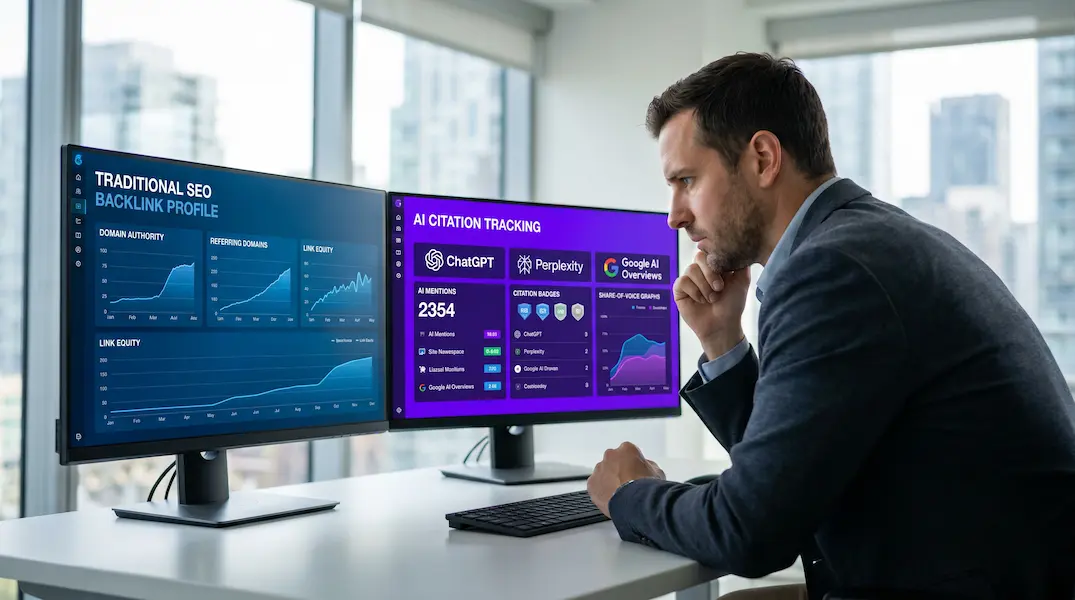
AI Citation Tracking: How to Monitor When ChatGPT, Perplexity, and AI Overviews Cite Your Brand
AI citation tracking is the process of monitoring how frequently AI platforms, including ChatGPT, Perplexity, Google AI Overviews, and Gemini, reference a brand, webpage, or author inside generated answers. It replaces click-and-ranking metrics with citation frequency, AI share of voice, sentiment, and AI-referred traffic as the primary measures of search visibility.
At Gallea Ai, our team runs weekly citation panels across multiple AI platforms for every SMB engagement. With 15+ years of combined AI strategy experience and as a credentialed IBM Silver Business Partner, we've seen that brands without citation tracking are optimizing blind.
Key Takeaways
- Large language models typically cite only 2–7 domains per response, far fewer than the ten blue links on a Google SERP, according to Averi.ai's 2026 GEO metrics guide.
- AI-cited content is 25.7% fresher than URLs in organic Google results, based on Ahrefs' 17-million-URL study.
- Brand search volume correlates with LLM citations at 0.334, the single strongest predictor identified per The Digital Bloom's 2025 AI Visibility Report.
- Only 11% of domains are cited by both ChatGPT and Perplexity, making cross-platform tracking essential, according to The Digital Bloom.
- Content with clear hierarchical formatting (headings, bullets, tables) is 28–40% more likely to be cited by LLMs, per Averi.ai's AI citation research.
What Is AI Citation Tracking and Why It Matters
AI citation tracking measures how often AI platforms reference a brand, website, or author in generated responses across ChatGPT, Perplexity, Google AI Overviews, and Gemini. It functions as the analytics layer for generative search, replacing click metrics with citation metrics.
Brand authority now lives inside AI-generated answers, not beneath them. A brand not cited in the 2–7 domains that LLMs quote per response is effectively absent from AI-mediated discovery.
Difference Between AI Citations and Traditional Backlinks
AI citations are references included in AI-generated answers, often as clickable source links or in-text citations. Backlinks are hyperlinks between websites that serve as signals in the web graph for ranking algorithms.
The mechanics and intent differ sharply:
| Dimension | Traditional Backlinks | AI Citations |
| What It Signals | Link equity between websites | Source trust inside AI generation |
| How It's Earned | Outreach, PR, content marketing | Brand authority, structured data, freshness, entity clarity |
| Primary Benefit | Improves search rankings | Surfaces brand inside AI-generated answers |
| Clickability | Typically clickable | Sometimes clickable (Perplexity, AI Overviews); sometimes not (ChatGPT parametric) |
| Measurement | Link-indexing tools | Prompt-panel monitoring tools |
In our audits of SMBs across financial services, food & beverage, and professional services, we consistently find backlink profiles that outperform category peers, yet with zero AI citation presence. The two signals are related, but one does not guarantee the other.
Key Metrics in AI Citation Tracking: Share of Voice, Citation Frequency
The defining KPIs for AI citation tracking shift measurement from volume to visibility-inside-answers.
- Citation Frequency — the percentage of monitored prompts where a brand is cited. Target 30%+ citation frequency for core category queries, according to Averi.ai's GEO benchmark guide.
- AI Share of Voice (AI SOV) — the brand's percentage of total citations inside a category compared to alternatives, tracked across every major AI platform.
- Citation Position — whether the brand appears in the primary answer block or in secondary references, because primary-block citations carry more weight.
- Sentiment — whether AI systems describe the brand positively, neutrally, or negatively in generated answers.
- Citation Source Quality — whether AI systems cite first-party pages, trusted third-party publications, or low-authority aggregators.
- AI-Referred Traffic — sessions attributed to LLM referrers, frequently misclassified as "direct" in legacy analytics.
How AI Systems Select and Cite Sources
AI systems select citations through two distinct pathways: parametric knowledge (training data) and retrieval-augmented generation (RAG) that queries live indexes at runtime. The pathway used determines which sources can realistically be cited.
According to The Digital Bloom's 2025 AI Visibility Report, 60% of ChatGPT queries are answered using parametric knowledge alone, while RAG-driven answers use hybrid retrieval (semantic search + BM25 keyword matching), resulting in a 48% accuracy improvement over single-method approaches.
Selection patterns vary by platform:
- ChatGPT — 87% of cited URLs match Bing's top 10 results; Wikipedia dominates at 47.9% of cited sources, per The Digital Bloom.
- Perplexity — Reddit leads at 46.7% of cited sources; indexes 200B+ URLs in real time.
- Google AI Overviews — 93.67% of AI Overview citations link to at least one top-10 organic result, averaging 10.2 links from 4 unique domains per response.
Research from Ahrefs' 17-million-URL AI citation study also shows ChatGPT specifically prefers URLs that are 393–458 days newer than organic Google results. Content freshness is now a first-class citation signal.
Top Tools and Platforms for Tracking AI Citations
The AI citation tracking tool market is young but maturing. Capable platforms share a common architecture: automated prompt panels, multi-model querying, citation extraction, competitive benchmarking, and trend dashboards.
Best Tools for Tracking Citation Data in AI Search Rankings
Evaluate AI citation tracking tools against seven criteria:
- Multi-platform coverage across ChatGPT, Perplexity, Google AI Overviews, Gemini, and Claude.
- Prompt panel infrastructure for running 200+ prompts per category on a weekly cadence.
- Citation extraction accuracy: the tool must identify exact source URLs, not just brand mentions.
- Citation gap analysis that flags prompts in which alternatives are cited, but the brand is not.
- Share-of-voice benchmarking against category peers across every monitored platform.
- Sentiment scoring inside generated answers.
- Exportable reporting with prompt-level drill-down, not aggregate vanity dashboards.
| Tool Category | Primary Function | Best Fit |
| Dedicated AI Visibility Platforms | Multi-model prompt monitoring, citation extraction, and AI SOV benchmarking | Agencies and teams running structured GEO programs |
| Enterprise SEO Suites (AI Modules) | Adds AI Overview tracking inside existing SEO dashboards | Brands with mature SEO operations layering GEO on top |
| AI Brand Monitoring Tools | Tracks brand mentions (not necessarily citations) inside AI outputs | Reputation and PR teams |
| Manual Tracking Workflows | Spreadsheet + scheduled prompt runs across free AI interfaces | Teams validating a stack before buying tooling |
| Custom Pipelines via APIs | Direct API queries to ChatGPT, Perplexity, and Gemini with scripted logging | Technical teams building bespoke dashboards |
How to Track AI Overview Citations on Google
Track AI Overview citations using Google Search Console, server logs, and direct prompt testing. Google Search Console surfaces AI Overview impressions under the standard Performance report, while server logs identify GoogleOther and AI crawler user agents. Direct prompt testing runs priority queries inside Google AI Mode, and logging cited URLs catches citations that analytics miss.
In our experience running citation panels for SMB clients, server logs plus weekly prompt testing catch three to four times more citation changes than dashboard metrics alone.
Setting Up an AI Citation Monitoring Workflow
A credible monitoring workflow standardizes the prompts, platforms, cadence, and response structure so that week-over-week trendlines are valid rather than noise.
- Define a prompt panel of 100–300 queries covering category, product, competitor comparison, and support intents.
- Baseline current citation frequency and AI share of voice across ChatGPT, Perplexity, Google AI Overviews, and Gemini. This is the reference point every future report compares against.
- Automate weekly prompt runs to control for model drift. AI models update continuously; static snapshots lie.
- Extract cited sources, not just brand mentions. Citation frequency without source URLs is unverifiable.
- Classify citations by position (primary answer vs. secondary reference) and sentiment (positive, neutral, negative).
- Map citation gaps, prompts where alternatives appear, and instances where the brand does not align with content inventory. This is the roadmap for the next content sprint.
- Feed findings into content engineering. Our team operationalizes this loop through Gallea AEO, restructuring pages into answer-ready blocks with embedded statistics and cited sources, because pages with clear formatting are 28–40% more likely to be cited, per Averi.ai.
- Deploy schema and entity updates at the template layer. We use Gallea AiOS, so JSON-LD (Article, FAQPage, Organization) is applied to every new page rather than one page at a time.
Mini Case Study: Financial Services SMB
- Goal: Help a financial services SMB establish an AI citation tracking baseline and earn citations inside AI Overviews and Perplexity for high-intent advisory queries.
- Challenge: The client had strong domain authority but no AI citation presence because the content lacked answer-ready structure, statistics, and clarity of entities.
- What We Did: Our team built a 220-prompt panel across four AI platforms, rebuilt the top 40 pages into answer-ready blocks with embedded statistics and cited sources, deployed FAQPage and Article JSON-LD through Gallea AiOS, and instrumented weekly citation tracking.
- Result: +581% organic traffic, +961% first-page impressions, 78 first-page keyword rankings, and $90,665 attributed revenue in 5 months.
Turning AI Citation Data into Actionable Strategy
Citation data is only valuable when it drives content decisions. The output of any monitoring workflow should be a prioritized backlog, not a dashboard that looks impressive and changes nothing.
How to Track AI Citations for Your Business Content
Track AI citations for business content by standardizing a prompt panel, running it weekly across ChatGPT, Perplexity, Google AI Overviews, and Gemini, and mapping every citation gap to a content action. The three moves that compound fastest are:
- Refresh stale content. AI-cited pages are 25.7% fresher than organic Google results on average, according to Ahrefs' study of 17 million cited URLs. Superficial date edits do not count. AI systems detect and ignore cosmetic refreshes.
- Add verifiable data. The peer-reviewed Princeton GEO study on arXiv found that adding statistics and citations to content drives measurable gains in visibility for generative responses.
- Close citation gaps. Every prompt in which an alternative is cited and the brand is not is a content briefing. Prioritize high-intent, high-volume queries first.
Our team also runs Gallea Brand Voice Pro across all publications, so tone, terminology, and entity naming remain consistent across web, chat, and voice because AI systems reward consistency across touchpoints.
Frequently Asked Questions About AI Citation Tracking
What is AI citation tracking?
AI citation tracking is the process of monitoring how often AI platforms, including ChatGPT, Perplexity, Google AI Overviews, and Gemini, reference a brand, webpage, or author inside generated responses. It uses automated prompt panels, citation extraction, and share-of-voice benchmarking to convert AI visibility into measurable KPIs.
How to track AI citations for your business?
Track AI citations for your business by running a standardized 100–300 prompt panel across ChatGPT, Perplexity, Google AI Overviews, and Gemini on a weekly cadence, extracting cited URLs, and mapping citation gaps to content actions. From what we've seen across financial services and food & beverage clients, the fastest ROI comes from refreshing top pages with statistics and cited sources, then re-running the panel two weeks later to quantify lift.
How to track AI overview citations?
Track AI Overview citations through three channels: Google Search Console Performance reports for AI Overview impressions, server logs filtered by AI crawler user agents, and manual prompt testing inside Google AI Mode. Cross-reference all three weekly; no single source catches every citation change.
Which platforms or services help track when AI systems cite my research?
Dedicated AI visibility platforms, enterprise SEO suites with AI modules, AI brand monitoring tools, and custom API-driven pipelines all support citation tracking. Based on our work with SMBs, the highest-ROI setup for a category-focused brand is a dedicated AI visibility platform layered on top of a structured prompt panel, not a general-purpose brand monitoring tool.
What are the best tools for tracking citation data in AI search rankings?
The best tools for tracking citation data in AI search rankings combine multi-platform prompt monitoring (ChatGPT, Perplexity, Google AI Overviews, Gemini), accurate citation URL extraction, AI share-of-voice benchmarking, sentiment scoring, and citation gap analysis. Evaluate candidates on prompt panel scale, platform coverage, citation extraction fidelity, and exportable reporting, not on branded marketing pages.
The Path Forward for AI Citation Tracking
AI-mediated discovery now mediates how buyers evaluate and choose providers. Brands without citation tracking are optimizing blind, and the data window, roughly six months before category incumbents build their own monitoring stacks, is narrowing. Prioritize the three moves that compound fastest: build a prompt panel, baseline citation frequency across every major AI platform, and feed citation gaps back into a content and schema roadmap.
To establish a verified AI citation baseline and a prioritized roadmap for your category, book a free 30-minute consultation with Gallea AI, no obligation, no sales pitch. Our team will assess your AI readiness and identify the 1–2 highest-ROI moves for your business.