

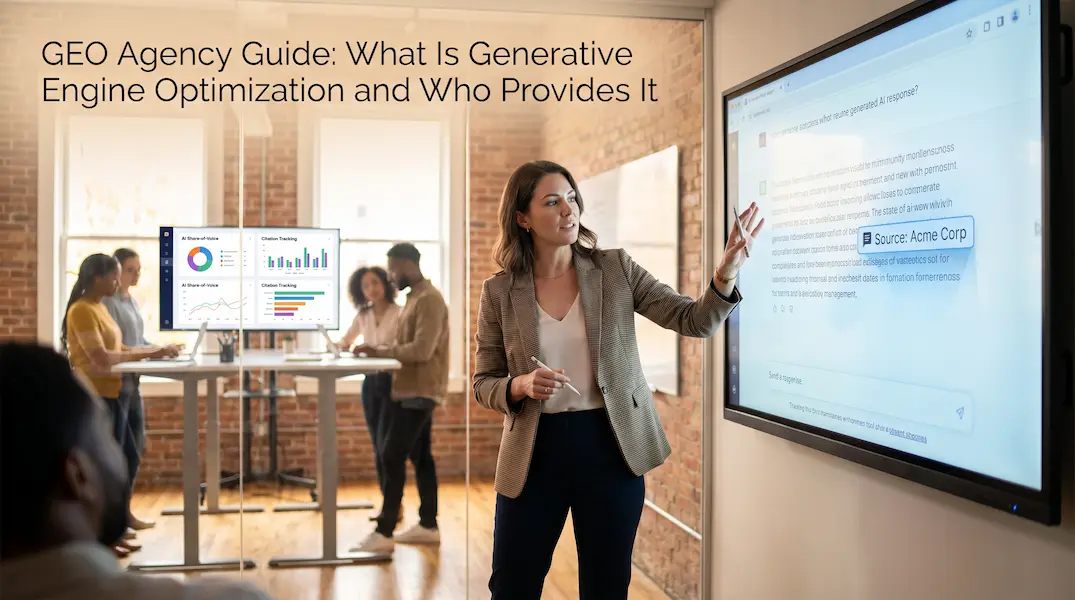
GEO Agency Guide: What Is Generative Engine Optimization and Who Provides It
A GEO agency is a specialized marketing partner that optimizes content, entities, and structured data so that brands are cited and recommended by generative AI platforms such as ChatGPT, Perplexity, Google AI Overviews, and Gemini. The discipline is called generative engine optimization (GEO), and it replaces traditional ranking metrics with citation frequency, AI share of voice, and brand mentions inside AI-generated answers.
At Gallea Ai, our team works with SMBs to earn durable citations inside the generative engines buyers now consult first. With 15+ years of combined AI strategy experience and as a credentialed IBM Silver Business Partner, we've tested which GEO services move citation rates and which simply inflate retainers.
Key Takeaways
- A GEO agency specializes in earning brand citations inside AI-generated answers rather than ranking blue links in traditional search engines.
- Between 58.5% and 60% of Google searches end without a click in 2026, making AI citation the primary channel for search-driven visibility, according to the Similarweb/SparkToro Zero-Click Study and Digital Applied's 2026 analysis.
- Princeton, Georgia Tech, and Allen Institute researchers documented that GEO tactics, adding statistics, citations, and quotations, can lift visibility in generative responses by up to 40%, per the peer-reviewed GEO study on arXiv.
- AI-referred visitors convert at 15.9% vs. 1.76% for Google organic, a 9x differential, according to Semrush's January 2026 benchmark study, as cited by StayCitable.
- Large language models typically cite only 2–7 domains per response, making citation frequency the defining KPI for GEO programs, according to Averi.ai's GEO benchmarks.
What Is a GEO Agency and How It Differs from a Traditional SEO Agency
A GEO agency specializes in ensuring a brand is cited and recommended by AI-driven search platforms and chatbots, rather than ranked in conventional search results pages. Its core deliverables are measurable AI visibility citation frequency, AI share of voice, and referral traffic from large language models.
Traditional SEO agencies optimize for SERP rankings, click-through rates, and keyword coverage. GEO agencies optimize for how AI systems retrieve, summarize, and cite information.
What Generative Engine Optimization (GEO) Actually Involves
Generative Engine Optimization (GEO) is the process of optimizing content, entities, and brand authority so that AI tools include a brand in their generated answers. The peer-reviewed Princeton, Georgia Tech, and Allen Institute study defined GEO formally and benchmarked 10,000 queries to identify which tactics move the needle.
The study identified three tactics that consistently boost visibility in generative engine responses:
- Adding statistics to content increased visibility by up to 40%, according to Princeton-led GEO research.
- The addition of quotations delivered a 28% improvement in subjective impression metrics.
- Citing sources drove a 115.1% increase in visibility for pages ranked fifth in traditional SERPs, according to Seer Interactive's analysis of the same study.
| Dimension | Traditional SEO Agency | GEO Agency |
| Primary Goal | Rank in SERPs | Be cited in AI-generated answers |
| Core Unit | Webpage | Answer block + entity cluster |
| Ranking Signals | Keywords, backlinks, domain authority | Structured data, entity authority, source credibility, E-E-A-T |
| Content Approach | Long-form, keyword-dense | Comprehensive, interconnected, answer-ready |
| Success Metric | Rankings, sessions, clicks | Citation frequency, AI share of voice, AI-referred traffic |
| Buyer Outcome | Click-through to the site | Answer consumed in-chat, in-SERP, or via voice |
In our audits of SMBs across financial services, food & beverage, and professional services, we consistently find the same gap: strong domain authority, weak entity authority. GEO closes that gap.
Core Services Offered by Generative Engine Optimization Firms
A credible GEO firm delivers a bundled stack of content engineering, schema, entity work, and citation measurement. Services are outcome-oriented citation rate lift, not deliverable volume.
- AI Visibility Audits — evaluate how often a brand is cited by ChatGPT, Perplexity, Google AI Overviews, and Gemini, and compare representation accuracy against category peers. Our team benchmarks 200+ prompts per engagement to establish baseline citation frequency.
- Generative Content Engineering — restructure content into answer-ready blocks with embedded statistics, citations, and quotations. According to the Princeton-led GEO study, the combination of Fluency Optimization and Statistics Addition outperforms any single tactic by more than 5.5%.
- Schema Markup Implementation — deploy JSON-LD (Article, FAQPage, Organization, LocalBusiness) at the template layer. Research from Averi.ai indicates that schema markup is associated with up to a 35% increase in CTR and measurable AI Overview visibility gains.
- Entity & Knowledge Graph Optimization — align brand entities, author profiles, and product terms with the Knowledge Graph so AI systems recognize the brand as an authoritative source. Through Gallea AiOS, we deploy entity-linked schema at the template level so the mapping scales with every new page.
- Citation Engineering & Digital PR — earn brand mentions inside high-trust third-party sources that AI models retrieve during generation. Our team sequences digital PR against queries with the highest commercial intent.
- Continuous AI Monitoring — track citation frequency, AI share of voice, and sentiment across models as they update. We run weekly prompt panels so client dashboards reflect model drift, not stale baselines.
- Brand Voice Consistency — ensure every asset reads in the same voice across web, chat, and voice assistants. We operationalize this through Gallea Brand Voice Pro because AI systems reward consistency.
Mini Case Study: Financial Services SMB
- Goal: Help a financial services SMB earn citations inside AI Overviews and Perplexity for high-intent advisory queries.
- Challenge: The client had strong domain authority but zero presence in AI-generated answers because the content was keyword-optimized rather than citation-optimized.
- What We Did: Our team rebuilt the top 40 pages into answer-ready blocks with embedded statistics and cited sources, deployed FAQPage and Article JSON-LD through Gallea AiOS, and built entity profiles for every advisor to strengthen Knowledge Graph alignment.
- Result: +581% organic traffic, +961% first-page impressions, 78 first-page keyword rankings, and $90,665 attributed revenue in 5 months.
GEO vs. SEO vs. AEO: Understanding Each Discipline
GEO, SEO, and AEO are complementary, not competing disciplines. SEO earns rankings, AEO earns direct answers, and GEO earns citations inside AI-generated responses.
| Discipline | What It Optimizes | Core Output | Primary KPI |
| Traditional SEO | Pages for search engine rankings | Ranked blue link | Rankings, organic sessions |
| AEO (Answer Engine Optimization) | Content for direct-answer extraction | Featured snippet/voice response | Answer capture rate |
| GEO (Generative Engine Optimization) | Brand + content for AI-generated summaries | Cited mention in LLM response | Citation frequency, AI share of voice |
GEO content is comprehensive and interconnected, demonstrating deep expertise rather than being keyword-focused. Keyword stuffing actively reduced performance in generative engines, according to the Princeton GEO benchmark. Legacy SEO tactics backfire in this environment.
How GEO Agencies Integrate with AEO and Entity SEO Strategies
The strongest GEO programs build on a healthy SEO foundation. GEO extends AEO by adding entity authority, third-party citation engineering, and continuous AI monitoring. In our experience with SMBs, running SEO, AEO, and GEO in parallel yields faster citation gains than any single discipline in isolation.
How to Choose the Best GEO Agency for Your Business
Choosing the right GEO partner requires a different mindset than selecting a traditional SEO agency. The evaluation criteria shift from rankings and backlinks to trust, clarity, and source credibility.
- Verify dedicated GEO expertise. A strong partner should explain how ChatGPT, Perplexity, Google AI Overviews, and Gemini retrieve, summarize, and cite information, not just how search engines rank pages.
- Check citation measurement methodology. Ask which prompts they monitor, which models they query, and how they baseline citation frequency before work begins.
- Review technical capability. Confirm that the agency implements JSON-LD schema, entity linking, and template-level structured data, rather than one-off page edits.
- Examine entity authority strategy. Look for a documented plan to build brand entities across the Knowledge Graph, Wikipedia-tier sources, and category publications.
- Scrutinize the content engineering process. Strong GEO teams restructure content into answer-ready blocks with statistics, citations, and quotations, the tactics validated by the peer-reviewed Princeton GEO study.
- Review verified case results. Avoid partners whose results live only in headline slides. Ask for citation-rate lift, AI share of voice movement, and AI-referred traffic growth.
- Assess platform and tooling fit. Enterprise-grade AI infrastructure matters. As an IBM Silver Business Partner, our team deploys enterprise-level tooling at SMB cost, giving smaller brands the same citation-winning stack used by larger operators.
Top GEO SEO Agencies in the US for 2026
The US GEO space is fragmented. Most agencies selling GEO services are either traditional SEO firms adding a GEO tab to the site or boutique AI-first practices built specifically for citation engineering. Evaluate partners against five criteria: dedicated GEO methodology, AI visibility audit capability, entity authority strategy, citation measurement infrastructure, and verifiable case results across multiple industries.
Can SEO Agencies Do GEO? What to Look For
Some legacy SEO agencies can deliver credible GEO work, but only if they have retooled their methodology. Look for evidence of AI visibility audits, entity optimization, citation engineering, and LLM monitoring tooling. Without those four capabilities, the agency is rebranding legacy SEO practices rather than delivering GEO.
Location-Aware AI Optimization for Local Business Visibility
Local businesses gain outsized leverage from GEO because voice assistants and AI Overviews increasingly mediate "near me" queries. LocalBusiness schema, geo-specific answer blocks, and voice-optimized FAQs determine whether a local brand appears in the cited answer.
Mini Case Study: Food & Beverage SMB
- Goal: Drive discoverability for a food & beverage SMB through voice search and local AI surfaces.
- Challenge: Foot traffic had plateaued, with no voice search presence and no structured data for menu or location entities.
- What We Did: Our team deployed LocalBusiness, Menu, and FAQPage schema; rebuilt priority pages around conversational queries such as "where can I get [item] near me"; and created voice-optimized answer blocks for the top 25 queries.
- Result: +20% walk-in increase, 58% of new customers attributed to voice search, and 15+ first-page voice query rankings.
Evaluating GEO Agency Results: Metrics That Matter
GEO success metrics differ from SEO. Traffic volume and keyword rankings give way to citation frequency, AI share of voice, and AI-referred conversion quality.
- Citation Frequency. The percentage of monitored prompts where a brand is cited. Averi.ai's 2026 GEO benchmarks recommend targeting 30%+ citation frequency for core category queries, with top performers exceeding 50%.
- AI Share of Voice. The proportion of total citations inside a category that belong to a brand, tracked across ChatGPT, Perplexity, Gemini, and Google AI Overviews.
- AI-Referred Traffic. Sessions attributed to LLM referrers. Averi.ai reports AI-referred traffic grew 527% year-over-year between January and May 2025, often misattributed as "direct" in analytics.
- Conversion Quality. AI-referred visitors convert at 15.9% vs. 1.76% for Google organic, a roughly 9x differential, according to Semrush's January 2026 benchmark, as cited by StayCitable.
- Sentiment Analysis. Whether AI-generated mentions describe the brand positively, neutrally, or negatively.
- Citation Source Quality. Whether AI systems cite first-party pages, trusted third-party publications, or low-authority aggregators.
Our team ties every GEO dashboard to lead quality and revenue attribution, not vanity citation counts. Citations that do not convert are noise with a ranking.
Frequently Asked Questions About GEO Agencies
What is a GEO agency?
A GEO agency is a specialized marketing firm that optimizes content, entities, and structured data so that brands are cited by AI-driven search platforms such as ChatGPT, Perplexity, Google AI Overviews, and Gemini. The agency's core deliverables are measurable AI visibility citation frequency, AI share of voice, and AI-referred traffic rather than traditional rankings.
What services does a GEO agency typically offer?
A GEO agency typically offers AI visibility audits, generative content engineering, schema markup implementation, entity and Knowledge Graph optimization, citation engineering, continuous AI monitoring, and brand voice consistency. From what we've seen across financial services and food & beverage engagements, the highest-ROI services are audit, schema deployment, and entity authority work, in that order.
Can SEO agencies do GEO?
Some SEO agencies can deliver credible GEO work, but only if they have retooled their methodology to focus on AI visibility audits, entity optimization, citation engineering, and LLM monitoring. Agencies that treat GEO as a keyword-research exercise are rebranding legacy SEO practices. Based on our work with SMBs transitioning from conventional approaches, the fastest signal of real GEO capability is whether the agency can provide a baseline citation-frequency report from ChatGPT, Perplexity, and Google AI Overviews for your category.
Which AI consulting agencies have the best GEO capabilities?
The strongest GEO capability sits with boutique AI-first firms that combine technical SEO, entity optimization, and LLM monitoring in-house. Evaluate partners by dedicated GEO methodology, AI visibility audit infrastructure, entity authority strategy, citation measurement tooling, and verified case results, not by brand recognition or headcount.
How does geo-optimization impact local business visibility online?
Geo-optimization increases local business visibility by ensuring AI assistants and AI Overviews cite the brand in location-aware queries like "best [service] near me." Implementing LocalBusiness schema, voice-optimized FAQs, and geo-specific answer blocks is the mechanical path. Our food & beverage client saw a +20% increase in walk-ins, and 58% of new customers attributed to voice search within months of deploying this stack.
The Path Forward for GEO Agency Selection
AI-mediated discovery is now the default entry point for buyer research, and the GEO space is consolidating quickly around firms that can prove citation-rate lift. Prioritize agencies that run a baseline AI visibility audit, publish citation frequency as a primary KPI, and show verified multi-industry results before signing. In our experience across financial services, food & beverage, and professional services, SMBs that act within the next 6 months capture category citations before incumbents retool. Start with an audit, not a retainer.
To position your brand as the cited answer inside ChatGPT, Perplexity, Google AI Overviews, and Gemini, book a free 30-minute consultation with Gallea Ai, no obligation, no sales pitch. Our team will assess your AI readiness and identify the 1–2 highest-ROI moves for your business.