


What Does It Actually Take to Appear in Google AI Overviews in 2026?
To optimize content for Google AI Overviews, write direct answers at the top of every section, structure pages with clear question-based headings, earn strong organic rankings, and build topical authority through content clusters. Google's AI Overviews use retrieval-augmented generation (RAG) to pull from indexed pages, which means foundational SEO and answer-first writing are the two most important levers you control.
Most businesses ranking on page one are still losing clicks; they do not realize it. According to research from Ahrefs, AI Overviews now reduce the click-through rate for position-one content by 58%, meaning you can rank first and still watch more than half your expected traffic disappear. Our team at Gallea Ai works with SMBs across financial services, food and beverage, and professional services to close exactly that gap. With more than 15 years of combined AI strategy experience, we have seen firsthand how businesses that structure content for AI citation rather than just keyword ranking protect and grow their inbound traffic as search behaviour shifts.
What You'll Learn
- AI Overviews appear on approximately 13-48% of Google searches, depending on query type and industry, making AI visibility a core business metric, not a side project.
- Only 38% of AI Overview citations now come from pages ranking in the top 10, down from 76% a year ago, because Google's AI sources from the full topic cluster, not just the highest-ranked page.
- 85% of AI Overview citations come from content published in the last two years, with 44% from 2025 alone. Freshness is a direct citation signal.
- Google confirms that RAG and query fan-out are the two core mechanisms AI Overviews use to reward interconnected content and direct-answer formatting.
- Google launched dedicated Generative AI performance reports in Search Console on June 3, 2026, giving site owners an official, separate view of AI Overview impressions for the first time.
How Do Google AI Overviews Select and Surface Web Content?
Google AI Overviews selects content by running retrieval-augmented generation (RAG) across the live search index, then synthesizing passages from multiple ranked pages into a single AI-generated summary. The system reads the same indexed content as traditional search engines do. According to Google's official documentation, your page must be indexed and eligible to appear in Google Search with a snippet before it can appear in any generative AI feature.
The second mechanism is query fan-out. When a user searches, Google's AI does not just match the original query; it generates multiple related sub-queries behind the scenes. According to Ahrefs' March 2026 study of 863,000 keywords and 4 million AI Overview URLs, pages ranking for fan-out sub-queries are 161% more likely to be cited than pages ranking only for the main keyword. This explains why the citation share from the top 10 pages dropped from 76% to 38% between mid-2025 and early 2026. Google's AI now pulls from the full topic cluster, not just the highest-ranked page.
This shift changes what "optimization" means in practice. A single well-crafted page no longer guarantees citation. You need a set of interconnected articles, each addressing a different angle of the same topic. SE Ranking's research shows that AI Overviews favour well-rounded content presenting multiple perspectives. The brands cited consistently are those with the deepest topical coverage, not necessarily the strongest individual rankings.
What signals does Google use to select sources for AI Overview?
- Organic ranking position: Position #1 carries a 33.07% citation probability; position #10 drops to 13.04%, according to an analysis of over 1 million AI Overviews
- Topical authority: Pages with comprehensive Schema.org markup are significantly more likely to be cited than pages with identical ranking positions but no structured data
- Content freshness: Only 12.32% of cited sources were published within 30 days, suggesting AI systems reward established trust over raw recency
- E-E-A-T signals: Google's AI specifically upweights content from sources that demonstrate genuine expertise, experience, and trustworthiness
- SERP feature appearances: SE Ranking's data shows AI Overviews appeared with at least one other SERP feature 99.25% of the time, meaning Featured Snippet and People Also Ask optimization directly improves AI Overview eligibility
The practical takeaway: ranking high still helps, but it is no longer the only path in. A page ranking outside the top 100 for the original query can still be cited if it answers a sub-question Google generates during fan-out. For SMBs, this is a genuine opening for deep topic clusters to compete with larger domains on AI citation, even when individual keyword rankings fall short.
What Content Formatting Strategies Earn AI Overview Citations?
Content that earns AI Overview citations shares a consistent structure: a direct answer at the top, question-based headings, short paragraphs, and information organized into lists or tables. These are not stylistic preferences; they are the formats that make it easiest for Google's Gemini 3 model to extract a clean, citable passage from your page. According to SE Ranking, definition sections with a "What is" H2 followed by a 2–3 sentence answer are among the most consistently cited content formats in AI Overviews.
The reason answer-first writing works is mechanical. Gemini uses RAG to retrieve passages and synthesize them into an overview. Passages that lead with a direct factual answer are simpler to extract intact. Passages buried after two paragraphs of preamble require the model to do more inference, and more inference means a higher chance of distortion or being skipped entirely. Writing for AI extraction is not about tricking the system; it is about removing friction between your knowledge and the model's citation.
When we audit client content at Gallea Ai, buried answers are the single most common missed opportunity. A page may hold the best available information on a topic, but if the direct answer sits in paragraph four, the AI skips past it. Moving that answer to the section's first sentence, with supporting context following, is often the one change that shifts a page from "indexed and present" to "cited in the Overview."
Answer Capsule Format: The 40-60 Word Sweet Spot
An answer capsule is a standalone 40–60-word paragraph that directly answers the question implied by the nearest heading. The word count is deliberate: long enough to be substantive, short enough to extract without truncation. According to published guidance on structuring answer capsules for AI extraction, the format requires a single clear takeaway, direct relevance to the query, and zero filler.
Each answer capsule follows this structure:
- Open with a plain-fact sentence that directly answers the heading question (no qualifiers, no "it depends")
- Follow with one clarifying sentence that adds the most important supporting context
- Close with one specific detail, a number, a condition, or a named example that makes the answer independently citable
This structure mirrors how Featured Snippets are written. SE Ranking's data shows that content optimized for Featured Snippets has a significantly higher likelihood of appearing in AI Overviews, as the two formats reward identical structural patterns. Optimize one, and you optimize for both.
How to Structure Headings for AI Summary Extraction
Structure headings as questions a real user would type into Google or say to a voice assistant. When Google's AI generates sub-queries during fan-out, it produces natural-language questions. Headings that match those patterns let your page answer the sub-query directly no inference required. According to senior SEO practitioners cited by Position Digital, question-based headings are among the most reliable structural signals for AI Overview citations.
Follow these heading rules for AI extraction:
- Every H2 asks a question a real user types or says, not a topic label like "Benefits of X"
- Every H3 narrows the H2 question to be specific, answerable, and not abstract
- The paragraph immediately below each heading directly answers it; the answer cannot be delayed or split across multiple paragraphs
- Use descriptive, specific language in headings, "What Are the Three Types of Schema Markup?" outperforms "Schema Overview"
- Mirror People Also Ask phrasing review PAA boxes for your target topic and match their structure, since PAA and AI Overviews share selection logic
Avoid heading formats like "A Deep Dive Into X" or "Everything You Need to Know About Y." These are unfocused and give the AI no extractable answer to pull. A heading that asks a clear question promises an answer, and AI systems capitalize on that promise.
What Structured Data and Schema Drive AI Overview Inclusions?
Structured data does not guarantee AI Overview citations, but it significantly increases your odds. Pages with comprehensive Schema.org markup are meaningfully more likely to be cited than pages with identical ranking positions but no structured data. Google's official documentation confirms that while structured data is not required for AI features, it helps AI systems interpret your content more accurately, which directly affects the likelihood of citations.
The key distinction is purpose. Structured data is not about gaming AI selection. It provides explicit context that removes ambiguity. When Google's model retrieves your page, schema markup communicates, in machine-readable terms, what type of content it is, who wrote it, what questions it answers, and what steps it describes. That clarity makes your content easier to extract, attribute, and cite with confidence. SE Ranking explicitly recommends implementing Article, FAQ, HowTo, and Reviews schema as the complete technical foundation for AI visibility.
Technical health underpins all of it. Schema only works on pages that Google can fully crawl and index. According to SE Ranking's Website Audit documentation, a comprehensive technical audit can surface more than 115 distinct issues, each a potential barrier to your content being cited. Image compression, mobile optimization, HTTPS, and Core Web Vitals all form the baseline AI systems required before treating a page as a reliable source.
What Kind of Structured Data Helps My Site Appear in AI Summaries?
The schema types most directly relevant to the AI Overview citation are Article, FAQPage, HowTo, BreadcrumbList, and Organization. All should be implemented as JSON-LD, the format Google officially recommends, inserted in the <head> of each relevant page.
| Schema Type | Why It Matters for AI Overviews |
| Article | Tells Google your page is a substantive editorial resource with a defined author, publish date, and update date, three signals that directly improve E-E-A-T assessment |
| FAQPage | Marks up Q&A pairs explicitly, making answer extraction near-trivial for AI systems; directly maps to the answer capsule format AI Overviews favour |
| HowTo | Structures step-by-step content with named steps and optional images, matching the numbered-list format AI Overviews commonly cite for procedural queries |
| BreadcrumbList | Communicates site structure and topical hierarchy, supporting the content cluster architecture that drives fan-out citation |
| Organization | Anchors your brand entity name, URL, logo, and contact details, enabling AI systems to reference your brand by name in answer text, not just as a source link |
The most underused type is FAQPage. Most content teams apply it only to dedicated FAQ pages, but it belongs on any page with question-based headings followed by direct answers, which describes every well-structured content page. Most sites are leaving schema-level AI attribution on the table across every article they publish.
One case study from our work shows what happens when this is done right. A real estate rental client in Toronto restructured their location-specific service pages with the FAQPage and Organization schema, added answer capsules under every H2, and filled topical gaps by creating a content cluster covering common tenant policy questions. Within weeks, the client's pages began appearing in Google AI Overviews for competitive pet-friendly rental queries, with the client cited directly by name in the AI-generated answer.
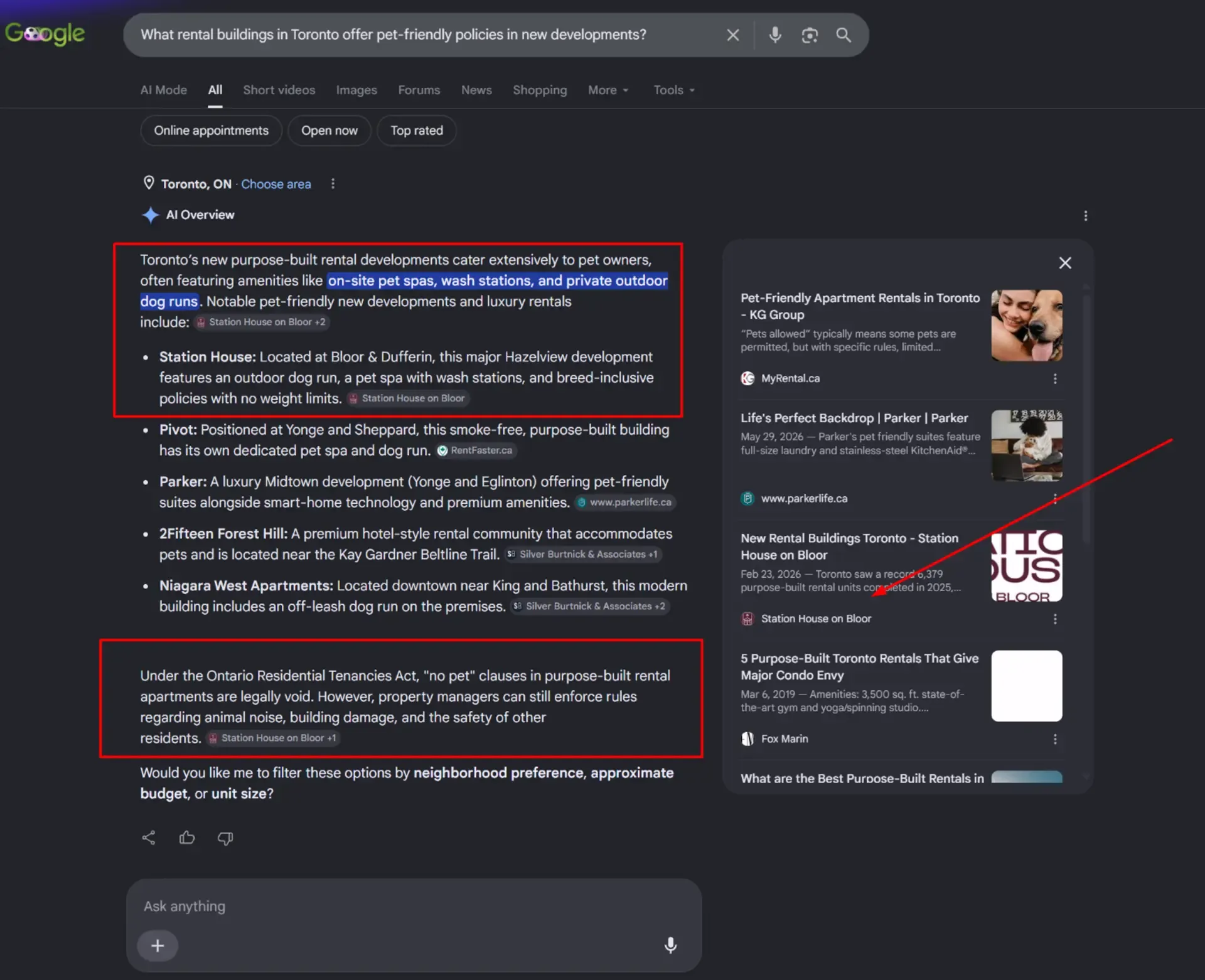 The screenshot shows Station House on Bloor surfaced in a Google AI Overview for a high-intent local rental query. The AI Overview pulls specific pet-friendly amenities, such as an outdoor dog run, a pet spa, wash stations, and breed-inclusive policies, directly from structured, answer-first content on the property's site. Schema and content structure working together produce this outcome: a named brand recommendation inside the AI answer, not just a buried source link.
How Do You Measure Your Presence in Google AI Overviews?
Measuring AI Overview presence requires combining Google Search Console's new Generative AI reports with third-party AI visibility tools. Search Console shows impressions but not citations, while third-party tools show citations but not always full impression data. Neither source alone tells the full story. According to Google's official announcement on June 3, 2026, Search Console now offers dedicated Generative AI performance reports that, for the first time, separate AI Overview impressions from traditional organic impressions.
According to RanketAI's technical breakdown of the new GSC reports, the reports currently show impressions, pages, countries, devices, and date trends, but no click data. You can confirm your content appeared in an AI Overview, but you cannot yet measure how many users clicked through. Google has stated additional metrics will follow; for now, pair GSC impressions with Google Analytics 4 referral traffic to approximate click-through behaviour.
Tracking Impressions and Clicks from AI Overview Panels
Start with three metrics: AI impression volume, target query coverage rate, and organic traffic trend for AI-eligible queries. Together, these reveal whether your content is appearing in AI answers, how thoroughly you cover your target topic, and whether AI visibility is converting into actual visits. According to Fanatic Design's measurement framework, aligning GSC impression data with your SEO tool's AI Overview presence data using the keyword as the shared key exposes the gap between ranking well and being cited.
Measurement stack for AI Overview performance:
- Google Search Console (Generative AI report): Baseline impression counts by page, country, and device; available as of June 3, 2026 with wider rollout planned
- SE Ranking AI Overviews Tracker: Shows whether your domain is cited for target keywords, with historical snapshots and competitor comparisons
- Semrush Position Tracking (AI Overview module): Tracks AI Overview appearances across tracked keywords; included in Semrush Pro plans
- BrightEdge: Enterprise-grade tracking with intent-matching analysis; suited to larger teams
- Google Analytics 4: Cross-reference organic landing page traffic against GSC AI impression data; segment informational vs. commercial queries separately, as AI Overviews affect these at different rates
- Manual sampling: Query target keywords in an incognito window and record citation presence; essential for topics where AI tools have limited keyword coverage
Track before and after every content change. Each time you add an answer capsule, restructure a heading, or publish a cluster article, log the date and run a four-week comparison. According to Position Digital, content refreshes with new, original data can produce measurable improvements in AI citations within weeks, but only when starting from a clean baseline.
The numbers make the urgency clear. A randomized field experiment published in April 2026 found organic clicks drop 38% on queries where AI Overviews appear, with zero-click searches rising from 54% to 72%. Businesses without an AI Overview measurement in place are flying blind on more than a third of their search exposure.
What Are the Best Tools to Audit and Improve AI Overview Performance?
The most effective AI Overview audit combines a technical SEO audit, a content structure review, and an AI citation monitoring tool in that order. Technical eligibility must come first because schema and content structure cannot surface a page that Google cannot fully crawl. Once crawlability is confirmed, content structure becomes the primary citation variable.
Research from Position Digital found that one client earned AI Overview citations for 96 keywords after a focused content effort, an answer-first structure, question-based headings, and FAQ sections, resulting in 809% growth in AI referral traffic and a 169% increase in organic conversions. The gain came from structural discipline, not new technology.
Agencies and Services That Specialize in AI Overview Optimization
Specialized AI Overview optimization work combines AEO strategy, content restructuring, schema implementation, and AI citation monitoring, four skill sets that most internal teams do not have assembled together. As an IBM Silver Business Partner, Gallea Ai brings enterprise-level AI and cloud tooling to SMBs without the overhead of large agency retainers. Our Gallea AEO service is built specifically to get businesses cited as the answer in Google AI Overviews, ChatGPT, Perplexity, and voice assistants.
The results from our client work show what a structured AEO program produces. When we partnered with a financial services client, we executed a full content restructure: answer-first section openings, question-based H2 and H3 headings, FAQPage and Article schema across key pages, and a content cluster covering the entity relationships their target audience searches. The outcome: a 581% increase in organic traffic, 961% growth in first-page impressions, 78 first-page keyword rankings, and $90,665 in attributed revenue within five months.
The same approach works across industries with different intent profiles. A food and beverage client needed to appear for local, near-me queries, particularly voice searches. We structured their location pages with HowTo schema, embedded answer capsules for common customer questions, and built a cluster targeting the voice-search patterns their audience uses. The result: a 20% increase in walk-in customers, with 58% of new customers attributing their visit to voice search, and 15+ first-page voice query rankings.
For businesses that want to assess their AI readiness before committing to a full program, Gallea AiOS turns a static website into a smart conversion system with personalization, lead qualification, and buyer routing, ensuring that the higher-intent traffic AI Overviews send actually converts. AEO gets you cited; AiOS makes every citation count.
A health and nutrition client we worked with had strong organic rankings but no systematic way to confirm AI citation. After implementing our AEO audit and content restructuring, their pages began appearing directly within Google AI Overviews for competitive product queries, confirming that structured content, not just ranking position, drives citations.
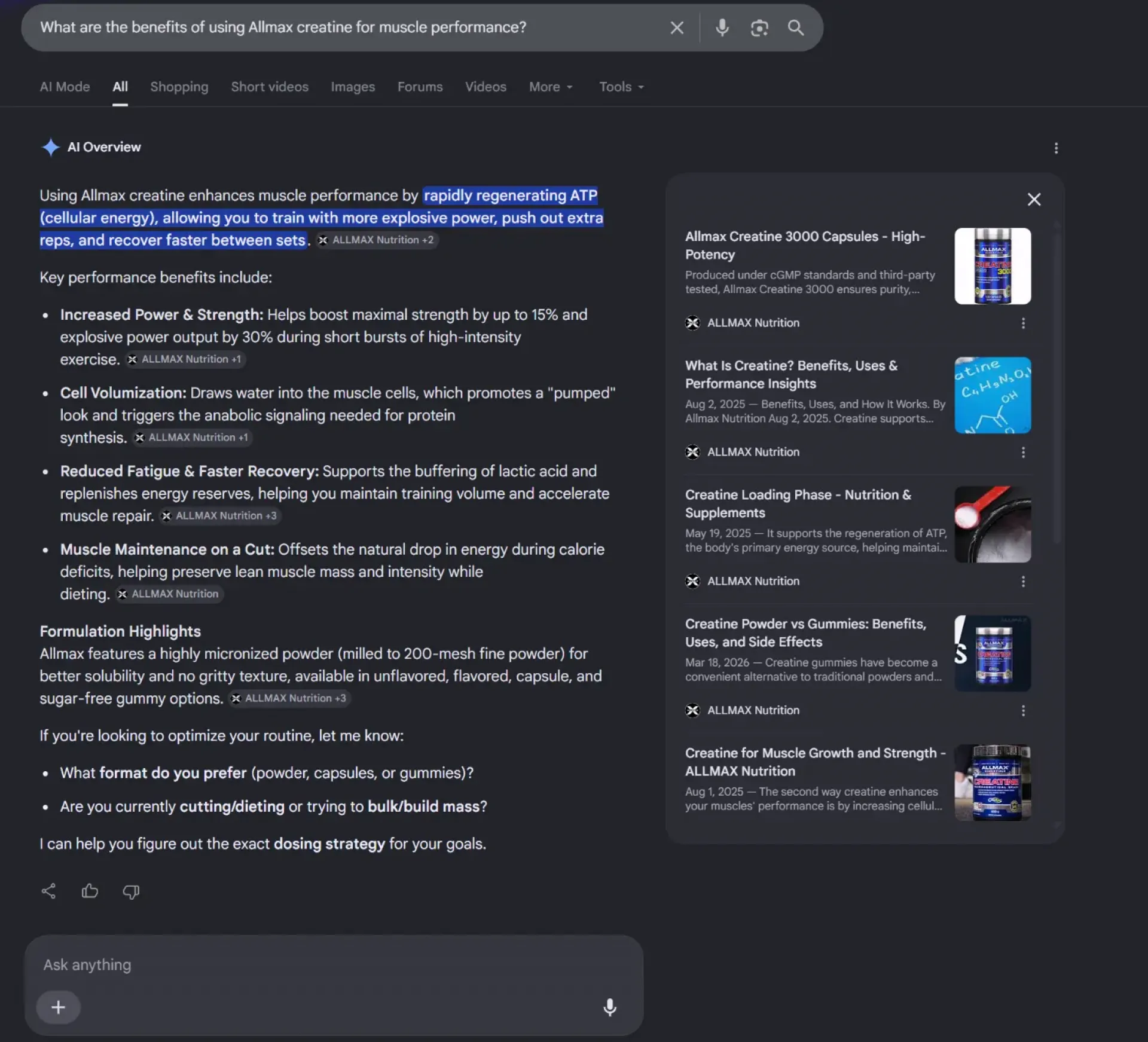 The screenshot shows ALLMAX Nutrition cited inside a Google AI Overview for a high-commercial-intent health query. The AI Overview surfaces specific performance benefits, ATP regeneration, cell volumization, reduced fatigue, and muscle maintenance extracted from structured, entity-specific content on ALLMAX's site. Citation at this level of detail requires answer-first formatting and clear factual organization; ranking position alone does not produce it.
What capabilities define a strong AI Overview optimization service?
- AEO audit: Full assessment of current AI citation presence, content structure gaps, and schema implementation errors across target pages
- Content restructuring: Rewriting existing pages with BLUF formatting, answer capsules, and question-based heading hierarchies
- Schema implementation: JSON-LD markup for Article, FAQPage, HowTo, and Organization on every relevant page
- Content cluster development: Identifying and filling topical coverage gaps that query fan-out exposes
- AI citation monitoring: Ongoing tracking of brand mentions across Google AI Overviews, ChatGPT, and Perplexity
- Measurement and reporting: Attribution from AI impression to organic traffic to lead conversion
What Is Your AI Overview Action Plan?
The path forward is a sequence, not a sprint. Fix technical crawlability first; every indexability issue is a barrier between your existing content and AI citation. Then apply answer capsules and question-based headings to your highest-traffic pages. Then build outward into topic clusters that cover the sub-questions generated by the fan-out. Each layer compounds the one before it: stronger structure improves ranking, stronger ranking improves citation probability, and broader citation coverage turns AI visibility into measurable inbound leads.
According to data from Position Digital, AI referral traffic converts at 10-16%, compared to 2–5% for traditional organic. The clicks AI Overviews send are fewer but higher intent, which means citation is not just a visibility win; it is a lead-quality upgrade. The businesses dominating AI-driven search in 2026 are not reacting to traffic drops; they are already structured to be cited before those drops arrive.
To get your business cited in Google AI Overviews, ChatGPT, Perplexity, and voice assistants and turn that visibility into qualified leads, book a free 30-minute consultation with Gallea Ai. No obligation, no sales pitch. Our team will assess your AI readiness and identify the 1-2 highest-ROI moves for your business.