

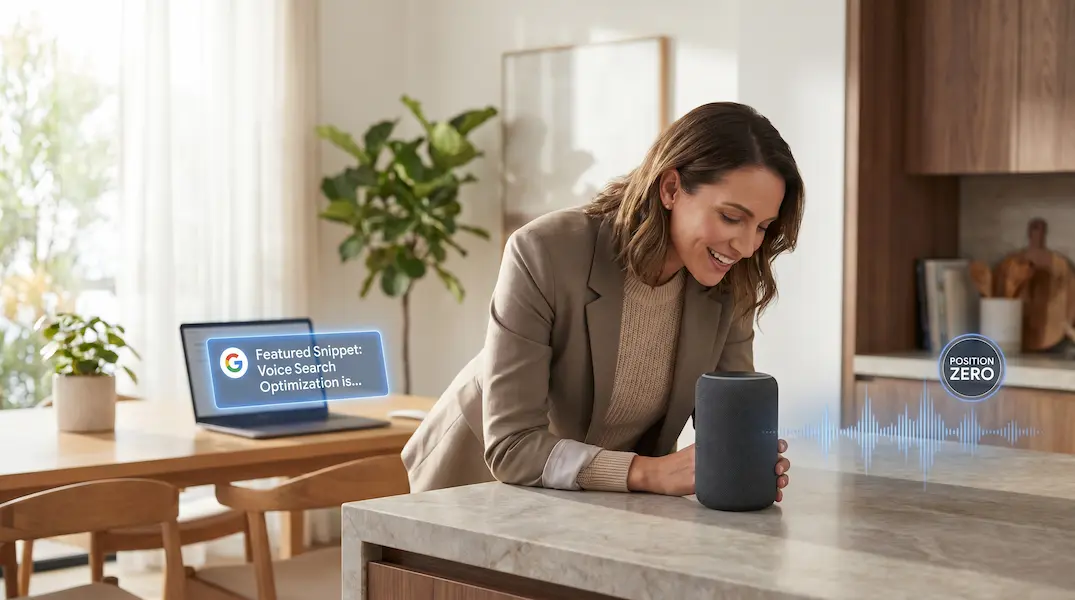
Voice Search Optimization: The Complete 2026 Guide
Voice search optimization is the process of structuring website content, technical markup, and local business data so that search engines and voice assistants, including Google Assistant, Siri, and Alexa, select your pages as the spoken answer to voice search queries. With 8.4 billion voice assistants in active use worldwide and over 1 billion voice searches performed every month, businesses that fail to optimize for spoken queries are invisible to a growing share of high-intent voice search users.
At Gallea Ai, our team works with SMBs to close the gap between traditional SEO and AI-powered answer extraction. As a credentialed IBM Silver Business Partner with 15+ years of combined AI strategy experience, we've seen firsthand how voice technology is reshaping digital marketing and how businesses that restructure content for conversational queries gain a compounding advantage across Google AI Overviews, Perplexity, Amazon Alexa, and Apple Siri. This guide documents every principle, tactic, and measurement framework we use in active client engagements.
Key Takeaways
- Voice search drives over 1 billion queries per month globally 58% of those queries carry local business intent, making local optimization a direct revenue driver.
- Featured snippets power 40.7% of voice search answers, making structured, answer-first content the single highest-leverage optimization available.
- Voice queries average 4.2 words and follow natural conversational language. Long-tail, question-based keyword targeting is not optional.
- Pages with FAQPage schema are 3.2x more likely to appear in Google AI Overviews and see up to 40% higher AI citation rates than equivalent pages without structured data.
- Answer Engine Optimization (AEO) and voice search optimization are converging disciplines. Content optimized for AI platforms like ChatGPT and Google AI Overviews automatically performs better in voice results.
What Is Voice Search Optimization and Why It Matters Now
Voice search optimization is defined as the strategic process of configuring website content, technical structure, and local signals so that voice-enabled devices return your business as the spoken answer to user queries. It differs from traditional search in that it targets spoken, conversational language rather than typed-text search keywords.
The scale of adoption makes inaction costly. According to Yaguara, 8.4 billion voice assistants are in active use worldwide as of 2024, and 153.5 million Americans currently use a voice assistant. Voice searches are growing at 9% year-over-year, according to Marketing LTB, and 27% of people use voice search on mobile devices. With 32% of consumers using a voice assistant in the past week as of 2025, this shift in consumer behavior confirms that voice is mainstream, not a future trend.
The commercial stakes are equally significant. The voice commerce market is on track to reach $194.03 billion in 2026, growing at a 29.1% CAGR, with projections reaching $484.09 billion by 2030, according to Research and Markets. For local businesses, the opportunity is more immediate: 46% of users look up local businesses by voice every day, per BrightLocal data via SeoProfy. Businesses without voice optimization are absent when a prospective customer is ready to act.
Voice Search vs. Traditional Typed Search: Key Differences
| Signal | Traditional SEO | Voice Search Optimization |
| Query format | Short keyword fragments ("pizza delivery NYC") | Conversational full sentences ("What's the best pizza delivery near me open right now?") |
| Average query length | 1–3 words | 4.2+ words (question-based) |
| Primary result format | Ranked list of blue links | Single spoken answer (position zero / featured snippet) |
| Local intent | Present but not dominant | 58% of all voice queries carry local intent |
| Schema priority | Helpful but optional | Required — FAQPage, HowTo, Speakable directly improve citation rates |
| Optimization target | Page rankings | AI extraction and featured snippet capture |
In our audits, we consistently find that businesses treating voice search as an afterthought have significant content gaps. Their pages answer the question of what they sell, not how people ask for it. Closing that gap, restructuring website content around conversational intent, is typically the highest-ROI search optimization available without adding new content.
How Voice Search Differs from Traditional Typed Queries
Voice search and typed search are fundamentally different user behaviors that demand different optimization responses. Understanding this distinction is the foundation of every strategy we build for clients at Gallea Ai.
How Voice Assistants Interpret Complex Queries
Voice assistants process spoken queries through a multi-stage AI pipeline. When a user asks a question, the device uses Automatic Speech Recognition (ASR) to convert the audio into text. Natural Language Processing (NLP) algorithms then analyze the transcribed query for intent, context, and entity relationships, applying semantic search principles rather than simple keyword matching. The search engine's Knowledge Graph and Retrieval-Augmented Generation (RAG) systems then identify the most authoritative, structured answer available and surface it as a spoken result.
According to Yaguara, voice assistants now answer 93.7% of queries correctly. Google Assistant accurately recognizes over 95% of English speech, per Marketing LTB. These accuracy improvements are driven by advances in NLP and entity recognition, meaning voice platforms and search engines understand semantic meaning, not just literal keywords. Content must be semantically rich and entity-optimized, not simply keyword-dense.
The practical implication: digital voice assistants deliver one voice search answer, not ten. That answer is almost always pulled from a featured snippet, a Knowledge Graph panel, or a highly structured FAQ response. If your content is not engineered for AI extraction, a competitor's content will be spoken instead.
Conversational Content Formats That Win Voice Results
Voice queries represent a fundamentally different form of conversational search. A typed query reads: "best accountant Toronto." The voiced equivalent reads: "Who is the best accountant near me for small business tax returns?" These are not the same query and require different content structures to answer them.
The BLUF (Bottom Line Up Front) principle governs every content block. Voice assistants parse the first sentence to assess whether it delivers a direct answer. If your opening is context-setting rather than providing the concise answers voice platforms prefer, your content gets skipped.
Featured snippets power 40.7% of voice search answers, according to Marketing LTB. 75% of voice search results come from the top 3 desktop results, meaning traditional SEO authority still matters, but content format determines whether a top-ranking page gets selected as the spoken answer.
Content formats that voice assistants prefer:
- Direct-answer paragraphs — 40-60 word responses to a single question, placed immediately below an H2 or H3 heading
- FAQ sections — Structured Q&A blocks written in a conversational tone using natural language that mirrors how people actually ask questions
- How-to lists — Numbered step sequences with active-verb opening phrases
- Definition blocks — Clear, declarative "X is defined as…" sentences that establish entity relationships for natural language processing parsers and help search engines index voice search results accurately
Voice Query Intent Categories
| Intent Type | Example Query | Optimization Response |
| Informational | "What is answer engine optimization?" | Direct definition paragraph + FAQ schema |
| Local/Navigational | "Best Italian restaurant near me open now" | Google Business Profile + NAP schema + LocalBusiness markup |
| Transactional | "Order a plumber in Newmarket" | Service schema + clear CTA + click-to-call markup |
| How-To | "How do I optimize my site for voice search?" | HowTo schema + numbered steps + Speakable markup |
| Comparison | "What's the difference between SEO and AEO?" | Comparison table + structured content + entity linking |
Proven Strategies to Optimize Your Content for Voice Assistants
Voice search optimization is not a single tactic; it is a structured, multi-layer program. The following steps reflect the exact methodology our team deploys for SMB clients across industries, including financial services, food and beverage, and professional services.
Step 1: Audit Content for Conversational Gaps
Identify pages that currently rank for typed keywords but fail to address the conversational version of those queries. In our audits, we use Google Search Console to filter for question-based queries that start with "what," "how," "where," "why," or "who," and then assess whether the page's content directly answers those questions within the first 50 words.
This step exposes what we call the "intent gap," the distance between what your page says and what your customer is actually asking. Closing this gap is the foundation of any effective voice search strategy. Restructure H2/H3 headings as questions and lead each section with a direct answer. This is typically the fastest ROI SEO strategy available without creating new content.
Step 2: Conduct Voice-Specific Keyword Research
Identifying voice search keywords requires tools and methods different from standard keyword planning. Voice queries average 4.2 words and use conversational keywords question-based, multi-word, and locally inflected natural language keywords that typed queries rarely capture. Long-tail keywords perform 2.5x better for voice search optimization than short-tail terms, per Marketing LTB, and account for 91.8% of all search queries according to Backlinko data via Embryo.
Recommended tools for voice-specific keyword research:
- AnswerThePublic — Visualizes question clusters around a seed topic, surfacing the "who, what, where, how, why" queries consumers actually ask
- AlsoAsked — Extracts Google's "People Also Ask" (PAA) data in hierarchical clusters, revealing the full question chain around a topic
- Google Search Console Query Groups — Google's October 2025 update introduced AI-powered Query Groups that cluster similar conversational queries into topic-level performance data, invaluable for identifying voice-driven traffic patterns
- People Also Ask mining — Directly mining PAA results for your core service categories surfaces the exact questions voice assistants are programmed to answer
- BrightLocal — Identifies local query data and "near me" phrase opportunities for location-based businesses
Target question phrases starting with: "How do I…," "What is the best…," "Where can I find…," "Who offers…," and "What does [X] cost?" These match the natural speech patterns that voice assistants and smart speakers are designed to resolve.
Step 3: Restructure Content with Answer-First Formatting
Every major content section must open with a direct, 40-60-word answer to the heading's question. This answer capsule is the extraction target for voice assistants, Google AI Overviews, and featured snippet algorithms. Voice platforms read the first response, not your entire web page. The goal is to create content that is genuinely user-focused, answering the user's question before providing supporting context.
Answer-first restructuring checklist:
- Place the direct answer in the first sentence after every H2/H3 heading
- Keep answer paragraphs between 40 and 60 words
- Use Subject-Verb-Object sentence structures for NLP clarity
- Bold primary and secondary entities on first use to establish entity relationships
- Follow the direct answer with supporting context, examples, and data
Research from ZipTie.dev and HubSpot's AEO case studies indicates that answer-first content restructuring delivers a 2–3x improvement in featured snippet capture rate and more than 30% increase in AI Overview visibility. This approach to structuring website content directly improves your odds of being selected as the voice search answer for your target audience's most common questions.
Step 4: Implement Voice-Ready Schema Markup
Structured data markup is the technical SEO bridge between your content and voice assistants. Schema markup in JSON-LD format helps search engines understand exactly what your content contains, making extraction and citation significantly more likely. Pages with schema markup are 33% more likely to appear in voice results, according to Marketing LTB. Pages with schema markup are also 36% more likely to be cited by AI, according to research from ZipTie.dev.
Priority schema types for voice search optimization:
- FAQPage schema — Pages with FAQPage markup see 28% higher citation rates from AI platforms and are 3.2x more likely to appear in Google AI Overviews than equivalent pages without FAQ structured data
- HowTo schema — Signals step-by-step instructional content for procedural queries, voice assistants prioritize these for delivering quick answers
- Speakable schema — Developed by Google and Schema.org, Speakable markup identifies the specific sections of a page best suited for audio playback, allowing Google Assistant to read marked content aloud on smart speakers
- LocalBusiness schema — Critical for near-me voice queries, encodes your business name, address, phone number, hours, and service area in machine-readable format
- Organization and BreadcrumbList schema — Establishes entity trust signals and site hierarchy data that AI systems use when selecting citation sources
Speakable JSON-LD implementation:
Digital Strategy Force documents the JSON-LD implementation using cssSelector to target specific HTML elements:
"@context": "https://schema.org/",
"@type": "WebPage",
"speakable": {
"@type": "SpeakableSpecification",
"cssSelector": [".answer-capsule", ".faq-answer"]
},
"url": "https://yoursite.com/page"
}
Apply cssSelector targeting to the introduction answer capsule, each FAQ answer block, and step-by-step HowTo answer summaries. Validate all schemas with Google's Rich Results Test before publishing.
As a credentialed IBM Silver Business Partner, Gallea Ai deploys enterprise-grade schema architecture, the same structured data frameworks used by large enterprise platforms, scaled for SMB websites without the enterprise complexity or cost.
Mini Case Study: Food & Beverage Client
Goal: Increase walk-in customer volume driven by voice and local search.
Challenge: The client had no schema markup, no optimized Google Business Profile, and zero first-page rankings for the voice queries their target customers used daily.
What We Did: Our team implemented a full structured data stack, including LocalBusiness, FAQPage, and Menu schema, then restructured the site's content to lead every section with a direct answer to the most common voice queries ("What time are you open?", "Do you have gluten-free options near me?"). We simultaneously audited and optimized the Google Business Profile for completeness, keyword relevance, and review velocity.
Result: The client saw a 20% increase in walk-in customers, with 58% of new customers directly attributing their visit to a voice search result alongside 15+ first-page voice query rankings.
Step 5: Optimize Local Presence for Near-Me Queries
Local SEO through voice is the highest-converting segment of voice search optimization strategies. When a consumer says, "Find a dentist near me open Saturday," they are moments from booking an appointment. 58% of voice searches are focused on local businesses, according to Circle S Studio. 76% of smart speaker users perform local voice search at least weekly, according to data from BrightLocal via BloggingX. Capturing that traffic requires more than quality website content.
Local voice search optimization requirements:
- Google Business Profile — Claim, complete, and actively maintain your profile. Ensure your Name, Address, and Phone number (NAP) are consistent across every directory, Google Maps, local listings, and social platforms
- Hyper-local content — Create location-specific FAQ pages and landing pages that answer neighborhood-level questions ("What's the best [service] in [specific area]?")
- Review velocity — Voice assistants weigh review quality and recency as a credibility signal. Encourage satisfied customers to leave reviews. Review velocity directly impacts local search performance and voice search rankings
- Service area and hours markup — Schema-encoded service areas and business hours make your operational data machine-readable, allowing voice assistants to answer "Is [business name] open now?" with your data
- "Near me" keyword integration — Naturally embed "near [city]" and "[service] in [neighborhood]" phrases in content, meta descriptions, and your business profile
82% of voice searches use long-tail keywords for near-me searches, according to Embryo. For local businesses investing in local SEO with the right local keywords, voice optimization is not an emerging trend; it is current buyer behavior that directly impacts search engine rankings.
Step 6: Achieve Technical Readiness for Voice Platforms
Voice assistants prioritize technically sound, fast-loading, mobile-first websites. The average voice search results page loads in 4.6 seconds, 52% faster than typical web pages, according to Marketing LTB. A slow-loading page will be skipped by search engines in favor of a faster competitor. Voice searchers expect fast, mobile-friendly experiences, especially on mobile devices, which account for 56% of voice searches.
Technical requirements for voice search:
- Core Web Vitals compliance — Google's benchmarks require Largest Contentful Paint (LCP) under 2.5 seconds, Interaction to Next Paint (INP) below 200ms, and Cumulative Layout Shift (CLS) under 0.1
- Mobile-first indexing — Mobile searches dominate voice interactions. Your site's mobile version is Google's primary crawl target. Responsive design, legible typography, and tap-friendly UI are non-negotiable; content must render identically across mobile devices and desktop computers
- HTTPS — HTTPS-secured sites account for 70% of voice search results, per Marketing LTB. Security is a prerequisite for AI citation consideration
- Crawlability — Clean navigation, XML sitemaps, and correct robots.txt configuration ensure search engines and AI crawlers can fully index your content
Gallea AiOS, our intelligent website optimization system, addresses these technical requirements by transforming static sites into high-performance, AI-ready conversion systems with personalization and intelligent buyer routing. Beyond speed and schema, AiOS increases the likelihood of converting voice-referred visitors with high purchase intent.
Step 7: Align with AEO for Cross-Platform Voice Coverage
Answer Engine Optimization (AEO) and voice search optimization are converging. Voice search technology on smart speakers, smartphones, smart devices, and in-car systems now draws answers from the same AI platforms that AEO targets: ChatGPT, Perplexity, Google Gemini, and AI Overviews. A content architecture optimized for AI citation automatically performs better in voice results.
Gallea AEO is our structured program for positioning businesses as the cited answer across ChatGPT, Perplexity, Google AI Overviews, and voice assistants. When our team audits a client's AI visibility, we assess every dimension of the AI citation stack: content structure, entity optimization, Knowledge Graph signals, schema deployment, and authority signals, then build a roadmap to close the gap.
Mini Case Study: Financial Services Client
Goal: Build AI platform visibility and organic authority to drive qualified lead flow without paid acquisition.
Challenge: The client was invisible in AI-generated answers and lacked structured content targeting the conversational queries their prospective clients use.
What We Did: Our team deployed a full AEO program, including answer-first content restructuring, FAQPage and Article schema implementation, entity optimization to establish Knowledge Graph presence, and a content velocity strategy targeting decision-level intent queries. Every article was built around a direct-answer capsule and structured to align with how AI platforms extract citation data.
Result: Within 5 months, the client achieved a 581% organic traffic increase, +961% organic first-page impressions, 78 first-page keyword rankings, and $90,665 in directly attributed revenue.
Measuring and Tracking Voice Search Performance
Voice search performance requires a composite measurement framework. Google Search does not provide a dedicated voice search filter, but voice search success can be inferred by triangulating proxy signals across multiple tools. Understanding where and how many voice searches happen across devices is essential for tracking voice search rankings and optimizing your ongoing voice search strategy.
Recommended Voice Search Tracking Stack
| Tool | Primary Use | Voice Search Application |
| Google Search Console | Query performance data | Filter for question-based, long-tail queries (5+ words); use Query Groups (Oct 2025) to cluster conversational traffic |
| BrightLocal | Local search tracking | Monitor local voice query rankings and "near me" impression data |
| AnswerThePublic | Keyword discovery | Identify new question clusters to target; monitor query volume shifts over time |
| AlsoAsked | PAA hierarchy mapping | Track which related questions you rank for in People Also Ask, a strong voice proxy |
| Rank trackers | Featured snippet monitoring | Identify featured snippet positions, which are the primary voice answer source |
| Google Business Profile Insights | Local visibility | Track call volume, direction requests, and profile views from voice-attributed local sessions |
Google Search Console Query Groups (launched October 2025) cluster similar conversational queries into topic-level performance data, which is particularly useful for surfacing the aggregate signal behind voice-driven, long-tail queries that individually fall below the anonymization threshold.
Key Performance Metrics for Voice Search
- Featured snippet capture rate — Approximately 40.7% of voice search answers come from featured snippets. Track which pages hold position zero and the query types triggering those results
- Question-based impression growth — Monitor impressions for queries starting with "what," "how," "where," "who," and "why" in Search Console. Sustained growth indicates voice optimization is working
- Local search actions — Call clicks, direction requests, and profile views in Google Business Profile are direct indicators of voice-to-conversion activity
- AI platform citation rate — Monitor how frequently ChatGPT, Perplexity, and Gemini cite your content. AI citations are a leading indicator of voice search authority
- Zero-click SERP impressions — Approximately 65% of Google searches in 2025 end without a click, per SparkToro/Datos data via Searchless.ai. Rising impressions alongside flat click-through rates can indicate your content is being surfaced and read aloud without a formal click attribution
In our experience working with SMB clients across industries, the brands that close the gap on voice search fastest treat measurement as an ongoing loop rather than a quarterly report. When you identify a question-based query that generates high impressions but has no featured snippet, that is an immediate optimization opportunity to restructure the target page's opening section to directly answer that query and deploy the appropriate schema markup.
Voice Search Optimization Frequently Asked Questions
How do I optimize my website for voice search?
Optimize your website for voice search by restructuring content around natural-language questions, implementing schema markup, and improving technical performance. Voice search helps businesses capture high-intent search queries that traditional methods miss. Execute these high-impact actions:
- Reformat existing content to lead with 40-60 word direct answers to specific questions below every H2/H3 heading
- Add FAQ sections to every core page using natural-language question headers
- Implement FAQPage, Speakable, HowTo, and LocalBusiness schema markup in JSON-LD format
- Achieve Core Web Vitals compliance, LCP under 2.5 seconds, INP below 200ms, CLS under 0.1
- Claim and fully complete your Google Business Profile with all category-specific attributes
- Migrate to HTTPS 70% of voice search results come from HTTPS-secured sites, per Marketing LTB
- Align content with AEO principles to maximize AI citation rates across ChatGPT, Perplexity, and Google AI Overviews
Prioritize pages that already rank in positions 2–5 for question-based queries. Those are the fastest-path opportunities for featured snippet capture, and featured snippets power 40.7% of voice answers.
What percentage of searches are voice searches?
Over 20.5% of people globally now use voice search, with more than 1 billion voice searches performed every month, according to Yaguara. The installed base of voice assistants has reached 8.4 billion devices worldwide. In the US, 153.5 million people used a voice assistant in 2025, and that figure is projected to grow. 32% of consumers used a voice assistant in the past week as of 2025, per BloggingX, and 56% of voice searches happen on smartphones, per Digital Silk. Most voice searches happen on mobile. Voice is not a niche behavior; it is a mainstream search channel growing at 9% year-over-year, with user behavior shifting decisively toward spoken queries.
Does voice search optimization help local businesses?
Yes, local businesses are the primary beneficiaries of voice search SEO. 58% of voice searches focus on local businesses, according to Circle S Studio, and 46% of users look up local businesses by voice every day, according to BrightLocal data via SeoProfy. 76% of smart speaker users perform a local voice search at least weekly.
From our work with a food and beverage client, we saw a 20% increase in walk-in customers after implementing local voice search optimization, with 58% of new customers attributing their visit directly to a voice search result. The combination of the LocalBusiness schema, answer-first content, and Google Business Profile optimization created a compounding effect that conventional SEO alone could not achieve. For businesses that serve a geographic area, local voice search queries represent the highest-ROI segment of this entire discipline. Accurate local business information across Google Maps and local listings is the baseline requirement.
What is speakable schema and how does it work?
Speakable schema is a JSON-LD markup type that explicitly designates content sections as eligible for text-to-speech delivery by voice assistants. It uses cssSelector or xpath properties to target specific HTML elements, as documented by Digital Strategy Force. In practice, you add a SpeakableSpecification block inside your WebPage schema and point it to CSS classes wrapping your answer capsules and FAQ answers. Google Assistant then prioritizes those flagged sections when selecting content to read aloud on smart speakers. Pages with schema markup are 33% more likely to appear in voice search results, according to Marketing LTB, and Speakable gives assistants an explicit, machine-readable signal about which content blocks to speak. Apply it to your introduction answer capsule, FAQ answers, and HowTo step summaries for maximum coverage of extraction.
How long does it take to see results from voice search optimization?
Most businesses see measurable results from voice search optimization within 3–6 months. Initial improvements, such as featured snippet capture for question-based queries, typically appear within 4–8 weeks of content restructuring and schema implementation.
Based on our experience at Gallea Ai, the timeline depends on your starting position and your target audience's search queries. Clients with existing domain authority and content that already ranks in positions 2–5 for question queries see the fastest returns. Our Food & Beverage client achieved 15+ first-page voice query rankings within 4 months of implementation. Businesses that execute content restructuring, schema deployment, and local optimization simultaneously, rather than in sequence, consistently achieve measurable results faster. Voice search optimization delivers compounding returns: the structured content and schema that wins voice results also improve featured snippet capture and AI Overview inclusion over time.
The Path Forward for Voice Search
Voice search is not an emerging trend; it is the current behavior of 8.4 billion smart devices and over 1 billion monthly queries. The businesses that win voice search in 2026 share a common trait: they have built content architectures that speak the way their customers ask. That means answer-first formatting, conversational keyword targeting, structured schema deployment, and a local presence optimized for near-me intent. It also means treating AEO and voice search optimization as the same discipline because AI platforms and voice assistants now draw from the same citation pool, and content that earns AI citations earns voice answers. The window to build that advantage before competitors do is narrowing.
To position your business as the cited answer in voice search, Google AI Overviews, and leading AI platforms, book a free 30-minute consultation with Gallea Ai, no obligation, no sales pitch. Our team will assess your AI readiness and identify the 1–2 highest-ROI moves for your business.