

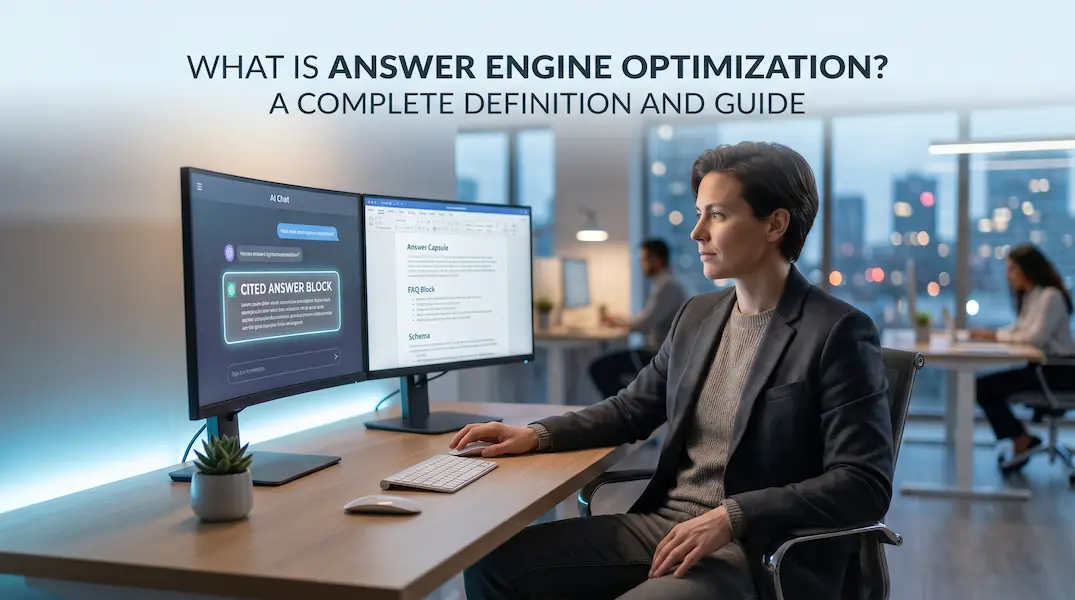
What Is Answer Engine Optimization? A Complete Definition and Guide
Answer Engine Optimization (AEO) is the practice of structuring content so AI systems and answer engines confidently cite it as the direct answer to a user's question. AEO aligns pages, entities, and structured data so platforms such as ChatGPT, Perplexity, Google AI Overviews, and voice assistants extract, trust, and quote the source. The discipline prioritizes clarity, modularity, and provenance over keyword volume.
At Gallea Ai, our team helps SMBs earn citations inside ChatGPT, Perplexity, and Google AI Overviews. With 15+ years of combined AI strategy experience and as a credentialed IBM Silver Business Partner, we've tested what gets extracted and what gets ignored.
Key Takeaways
- AEO targets "position zero," the cited answer users see or hear without clicking, a shift documented by Search Engine Land.
- Visitors arriving from AI search convert at roughly 4x the rate of traditional organic visitors, according to HubSpot's AEO case study.
- FAQ schema implementation is associated with a 28–40% citation likelihood increase, and pages with FAQPage schema are 3.2x more likely to appear in Google AI Overviews, according to research cataloged by Onely and ZipTie.dev.
- Schema markup is linked to 30%+ higher visibility in AI Overviews and up to a 35% CTR improvement from rich results, per the Averi.ai implementation guide.
- Full AEO programs can deliver 6x AI-referred signups and a 600% citation uplift within weeks of sustained publishing, based on HubSpot's Discovered Labs case study.
What Is Answer Engine Optimization?
Answer Engine Optimization (AEO) is the discipline of engineering web content for extraction and direct citation inside AI answer engines.
AEO prioritizes structured data, clarity, and entity relationships, not keyword density. The goal is to become the definitive answer that an AI system surfaces, summarizes, or speaks aloud. Being cited functions as a trust endorsement because AI selection signals topical authority.
What Does AEO Stand For in Marketing?
AEO stands for Answer Engine Optimization. Inside modern marketing stacks, it sits alongside SEO, content, and analytics as the layer responsible for AI citation capture. It governs how content is structured, marked up, and measured against AI-mediated discovery.
Answer Capsules: The Core Content Unit of AEO
An answer capsule is a 30–60-word self-contained response block placed at the top of each section. It leads with the direct answer, adds concise elaboration, then names the supporting entities. This compact structure mirrors how AI systems ingest, verify, and cite content.
| Component | Definition | Placement | Pro | Con |
| Answer Capsule | 30–60 word direct response | Top of section | Highest extraction probability | Requires editorial discipline |
| FAQ Block | Question-led H3 with direct reply | Mid-to-lower article | FAQPage schema eligible | Easily over-stuffed |
| Entity Cluster | Bolded primary + secondary entities | Throughout body | Strengthens Knowledge Graph mapping | Requires entity research |
| Trust Block | Author, last-updated, cited sources | Top of page | Signals provenance to answer engines | Needs maintenance cadence |
| Structured Data Layer | JSON-LD (Article, FAQPage, Organization) | Page <head> | Machine-readable context | Requires technical implementation |
In our audits of financial services and food & beverage SMBs, we consistently find that pages missing an answer capsule forfeit citation opportunities even when the underlying information is superior to that of a ranked competitor. The gap is structural, not substantive.
How Does AEO Work?
AEO works by making content machine-readable, so AI systems can extract, trust, and cite it as a direct answer. The mechanics rely on natural language processing (NLP), entity recognition, and schema markup to interpret structure and provenance before selecting a source.
- Research user intent around conversational queries and user questions. Our team runs query-intent mapping against ChatGPT, Perplexity, and Google AI Overviews to reverse-engineer which phrasings trigger citations.
- Structure every section with an answer-first capsule. Analysis from ZipTie.dev indicates that pages using the FAQ schema see a 41% citation rate, compared with 15% without it, and that H2>H3>bullet structures are roughly 40% more likely to be cited.
- Implement JSON-LD schema markup (Article, FAQPage, Organization). Through Gallea AiOS, we deploy validated JSON-LD at the template level so structured data scales across the entire site, not just the homepage.
- Map entities to the Knowledge Graph through consistent naming and internal linking, strengthening topical authority and disambiguation.
- Establish E-E-A-T through author bylines, last-updated timestamps, and cited sources. We lock these signals into every page using Gallea Brand Voice Pro, keeping authorship, expertise, and sourcing consistent across teams and AI tools.
- Measure citation frequency, AI visibility score, and voice-answer inclusion, not just clicks.
Which Platforms Does AEO Target: ChatGPT, Perplexity, AI Overviews, and Voice?
AEO targets four primary surfaces: ChatGPT, Perplexity, Google AI Overviews, and voice assistants. ChatGPT selects from training and retrieval; Perplexity uses real-time retrieval-augmented generation (RAG); Google AI Overviews runs a generative SERP layer; and voice assistants pull from sources adjacent to featured snippets.
Entity Recognition and Knowledge Graph Integration in AEO
Entity recognition is the NLP process by which AI systems identify and relate people, places, products, and concepts. Schema markup accelerates Knowledge Graph integration by supplying explicit, machine-readable signals. According to Search Engine Land's entity authority analysis, correctly implemented content knowledge graphs are tied to a 300% improvement in LLM response accuracy and a 20–40% traffic lift for sites deploying deeply nested, error-free advanced schema.
How AEO Improves Website Traffic and Brand Visibility
AEO shifts the measurement model from clicks to citations, impressions, and AI-referred traffic. The conversion trade is favorable: fewer visitors, higher intent. HubSpot's AEO case study reports 4x higher conversion rates and 13x higher MRR from AI referral visitors compared to other sources.
Research from Averi.ai also indicates schema markup is associated with up to a 35% CTR improvement from rich results, a direct lever for both visibility and click yield on surfaces that still list sources.
Case Study: Financial Services SMB
- Goal: Help a financial services SMB earn citations inside AI Overviews and Perplexity for high-intent advisory queries.
- Challenge: The client had strong domain authority but zero presence in AI-generated answers because the content wasn't structured for extraction.
- What We Did: Our team rebuilt the top 40 pages into answer-first capsules, deployed FAQPage and Article JSON-LD through Gallea AiOS, and implemented a trust block with author credentials on every article.
- Result: +581% organic traffic, +961% first-page impressions, 78 first-page keyword rankings, and $90,665 attributed revenue in 5 months.
Why Brands Are Investing in AEO in 2026
Brands invest in AEO because AI answer engines now mediate how buyers discover, evaluate, and choose providers. The surface that wins the citation wins the consideration set.
- Zero-click searches are rising. Visibility now lives inside the answer, not beneath it.
- Being named in AI answers acts as a trust endorsement stronger than a ranked link.
- AI search traffic converts at roughly 4x the rate of traditional organic, with 13x higher MRR, per HubSpot's AEO case study.
- AEO programs can generate measurable pipeline shifts within months. HubSpot's Discovered Labs case study documents a 6x increase in AI-referred signups and a 600% citation uplift within weeks, while Broworks reports roughly 2–4x qualified weekly leads after AEO implementation.
As an IBM Silver Business Partner, our team deploys enterprise-grade AI infrastructure at SMB cost, giving smaller brands the same citation-winning stack used by larger operators without enterprise complexity.
Case Study: Food & Beverage SMB
- Goal: Drive discoverability for a food & beverage SMB through voice search and local AI surfaces.
- Challenge: Foot traffic had plateaued, with no voice search presence and no structured data for menu or location entities.
- What We Did: Our team implemented LocalBusiness, Menu, and FAQPage schema; rebuilt priority pages around conversational queries such as "where can I get [item] near me"; and created voice-optimized answer capsules for the top 25 queries.
- Result: +20% walk-in increase, 58% of new customers attributed to voice search, and 15+ first-page voice query rankings.
How Do AEO and SEO Differ?
AEO and SEO work together. SEO earns rankings, AEO earns citations inside AI answers. AEO does not replace traditional SEO; it builds on a solid SEO foundation.
Traditional SEO optimizes for ranked lists of links, while AEO optimizes for direct, concise answers. SEO rewards long-form depth; AEO rewards modular, answer-first structure, FAQs, and short summaries. As research cataloged by Onely shows, FAQ-structured pages earn a 28–40% higher citation probability across ChatGPT, Perplexity, and Google AI Overviews than unstructured content rankings alone no longer guarantee AI citation.
| Attribute | Traditional SEO | Answer Engine Optimization (AEO) |
| Primary Goal | Rank in traditional search engine results | Be cited as the direct answer |
| Core Unit | The webpage | The answer capsule |
| Ranking Signals | Keywords, backlinks, domain authority | Structured data, entity relationships, clarity, E-E-A-T |
| Content Format | Long-form, keyword-optimized | Direct answers, FAQs, short-form summaries |
| Success Metric | Clicks, sessions, rankings | Citations, AI visibility score, AI-referred traffic |
| User Outcome | Click through to the site | Answer received in SERP, voice, or chat |
In our experience with SMBs, the highest-performing sites we manage run SEO and AEO in parallel; our team audits for both click-earning and citation-earning content on every engagement.
How Do You Get Started with Answer Engine Optimization?
Start AEO by auditing content for answer-first structure, deploying schema, and establishing E-E-A-T signals. The first 90 days determine whether a brand captures citations before category incumbents do.
- Audit the top pages for the presence of answer-capsules. Our team's first 72 hours on any engagement are spent on a citation-gap audit, mapping every priority page against extraction readiness.
- Rewrite top-of-section openings into 30–60-word direct answers.
- Deploy JSON-LD schema (Article, FAQPage, Organization) site-wide. Research from Averi.ai indicates schema markup can deliver 30%+ higher visibility in AI Overviews and measurable citation improvements within 90 days. We implement the schema at the template layer through Gallea AiOS, so it scales with every new page.
- Build a trust block (author, last-updated, sources) at the top of every page to anchor E-E-A-T signals.
- Publish at AEO velocity. According to HubSpot's Discovered Labs case study, AI citations can appear within 72 hours of publication, with a 600% citation uplift tied to sustained cadence.
- Measure via Google Search Console for featured snippet impressions, and monitor People Also Ask, knowledge panels, and AI-answer citations.
AEO programs must stay adaptive as answer engines evolve. Our team treats that adaptability as a service benefit; clients receive a running roadmap, not a one-time implementation. We use Gallea Brand Voice Pro to ensure every answer capsule a client publishes reads in the same voice across web, chat, and voice, because AI systems reward consistency.
Frequently Asked Questions About Answer Engine Optimization
What is answer engine optimization?
Answer Engine Optimization (AEO) is the practice of structuring content so AI systems and answer engines can confidently cite it as the direct answer to a user's question. It focuses on structured data, clarity, and entity relationships rather than keyword density.
What is AEO in digital marketing?
In digital marketing, AEO is the discipline of optimizing content, structured data, and entity signals so brands are selected as the cited answer inside ChatGPT, Perplexity, Google AI Overviews, and voice assistants. It marks the shift from click metrics to citation metrics. In our work with SMBs, we frame AEO as the bridge between legacy SEO visibility and AI-era discoverability.
What is answer engine optimization and how does it work?
AEO works by combining answer-first content structure, schema markup, and entity optimization so AI systems can extract, verify, and cite a brand's content as the definitive answer. The mechanics depend on NLP parsing, Knowledge Graph alignment, and E-E-A-T signals working in sequence.
How does Answer Engine Optimization work?
AEO works through four mechanics: answer-first capsules, JSON-LD schema markup, entity recognition alignment with the Knowledge Graph, and consistent E-E-A-T signals. AI systems parse structure and provenance before choosing a citation. Our team sequences these mechanics in that exact order structure before schema, schema before entities, entities before authority signals.
What are the benefits of implementing AEO in online advertising?
AEO benefits include higher-intent traffic, brand citations within AI answers, stronger conversion rates (roughly 4x vs. traditional organic), and durable visibility as search behavior shifts toward AI-mediated discovery. Based on our work across financial services and food & beverage clients, AEO functions as a competitive edge in a zero-click landscape, capturing visibility that legacy SEO practices alone can no longer guarantee.
The Path Forward for Answer Engine Optimization
AI-mediated discovery is now the default entry point for buyer research across industries. Prioritize the two highest-leverage moves: answer-capsule restructuring and schema deployment, before pursuing entity-graph work and voice optimization. In our experience across financial services, food & beverage, and professional services, SMBs that act within the next 6 months capture citations before category incumbents catch up. The consultation below is the fastest route to a prioritized, business-specific roadmap.
To position your brand as the cited answer inside ChatGPT, Perplexity, and Google AI Overviews, book a free 30-minute consultation with Gallea Ai, no obligation, no sales pitch. Our team will assess your AI readiness and identify the 1–2 highest-ROI moves for your business.