

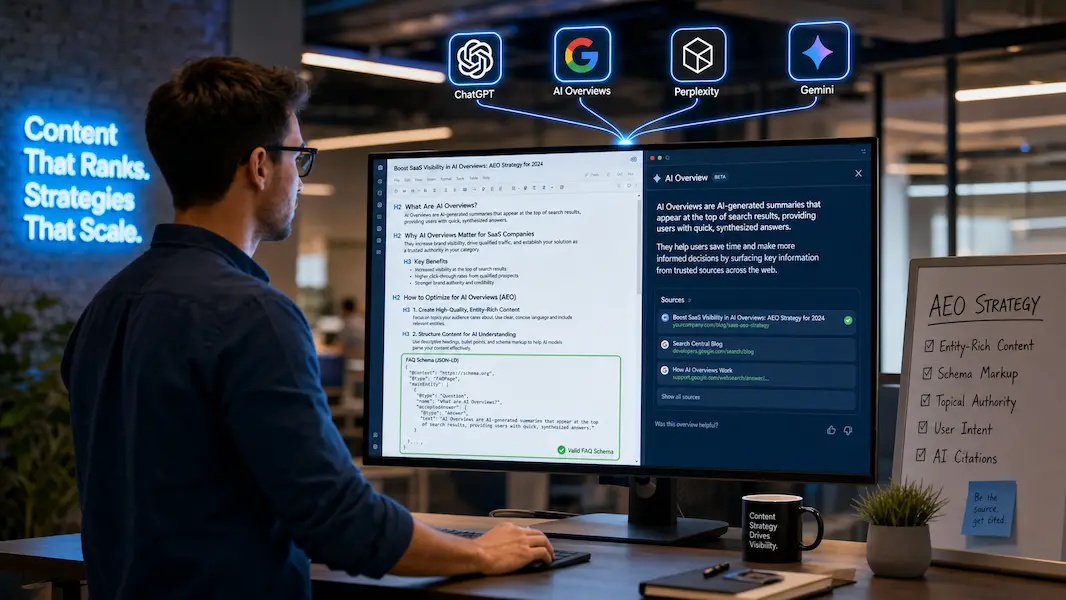
How Can I Improve My Website Content for AI-Driven Search Engines?
Improving website content for AI-driven search engines requires structuring original, expert-led information so AI systems like ChatGPT, Perplexity, Gemini, and Google AI Overviews can extract, verify, and cite it. The foundation is non-commodity content organized around clear question-answer pairs, supported by technical SEO, and reinforced by strong E-E-A-T signals that prove your content deserves to be quoted.
Most businesses understand they need better digital visibility. What they do not know is that the rules for earning it have changed fundamentally. At Gallea Ai, our team works with SMBs across financial services, food and beverage, professional services, and e-commerce to close the gap between what a business knows and what AI systems need to understand before they will quote that business as a source. With more than 15 years of combined AI strategy experience, we have seen firsthand how content that reads clearly for humans and signals authoritatively for machines consistently earns more citations, more qualified inbound leads, and a meaningfully lower cost per acquisition than content built for the old ranking game.
Key Takeaways:
- AI content optimization is the practice of structuring website content so that AI systems can extract and cite it as a direct answer, rather than just rank it as a blue link result.
- Zero-click searches reached 64.82% of all Google queries by 2026, according to Digital Applied, making AI citation the new primary measure of search visibility.
- Google confirms its AI Overviews and AI Mode rely on the same core Search ranking and quality systems, meaning foundational SEO remains the bedrock of generative AI visibility, per Google Search Central.
- E-E-A-T (Experience, Expertise, Authoritativeness, Trustworthiness) is the primary quality framework AI systems use to determine which content to feature, surface, and cite.
- Visitors arriving from AI platforms convert to sign-ups at 1.66%, more than 11 times the 0.15% conversion rate from traditional organic search, according to a Microsoft Clarity analysis of over 1,200 publisher websites.
What Are the Key Factors for Content to Appear in AI-Generated Search Results?
Content appears in AI-generated search results when it is original, technically accessible, well-structured, and authoritative enough for an AI system to trust as a verified source. Google's generative AI features use Retrieval-Augmented Generation (RAG) to retrieve relevant, up-to-date pages from the Search index and synthesize them into direct answers. If your content is not indexed, not crawlable, or not clearly organized around a distinct answer, it cannot be retrieved, regardless of how well it reads.
AI content optimization begins with a fundamental shift in purpose. You are no longer competing only for a position in a list of links. You are competing to become the sentence an AI quotes. According to Google Search Central's AI optimization guide, the single most impactful factor for long-term generative AI visibility is non-commodity content, original, expert-led information that provides a unique point of view a generative AI model could not produce on its own. Commodity content that restates what is already widely available is the fastest path to invisibility in AI-driven search, because AI systems have access to all of it and no reason to single out your version.
E-E-A-T is the quality framework underlying every AI citation decision. According to Google's Search Quality Rater Guidelines, Trust is now the foremost consideration supported by transparent authorship, first-hand experience, verifiable sources, and consistent reputation signals across platforms. In our audits, we consistently find that pages earning AI citations share three structural traits: a named author with documented credentials, at least one claim that could only come from direct experience, and external citations to verifiable sources. Gallea Ai's IBM Silver Business Partner status is a concrete example of a verifiable authority signal that tells AI systems that our expertise is credentialed and externally validated, not self-declared.
The Google Search Essentials define the baseline every page must meet to earn visibility in both traditional and AI search. The core best practices Google identifies are: creating helpful, reliable, people-first content; placing natural language in prominent locations like the title and main heading; ensuring links are crawlable so Google can discover related pages; and following specific best practices for images, video, structured data, and JavaScript so every part of the page is understood. Meeting these requirements does not guarantee indexing or citation, but failing them guarantees exclusion.
The key factors for appearing in AI-generated responses:
- Originality: First-hand experience, original data, and unique expert insight over recycled summaries
- Technical eligibility: Indexed, crawlable pages with correct HTTP status codes and no snippet-blocking directives
- Topical authority: Comprehensive, clustered content that covers a subject in depth, not isolated pages targeting individual keywords
- E-E-A-T signals: Named authors, external citations, verifiable credentials, and consistent brand mentions across platforms
- Structural clarity: Question-based headings, direct answer paragraphs, and logical content hierarchy that AI can parse by section
- Recency: Regular content updates with visible timestamps signaling currency and reliability to AI systems
- Page experience: Fast-loading, mobile-friendly pages that help users navigate to the main content without friction
Generative engine optimization is not a separate discipline from SEO. Google is explicit: optimizing for generative AI search is optimizing for the search experience, which means answer engine optimization and foundational SEO are the same work, executed with AI citation as the target outcome.
How Do I Structure Articles to Be Effectively Summarized by AI Assistants?
AI assistants summarize articles by breaking pages into sections and retrieving the most relevant passage for each user query. The heading structure of your article is the map that tells an AI system where each distinct idea begins and ends. According to RESO AI, when headings are inconsistent, vague, or absent, strong content can still rank but fail to appear in any AI-generated answer because the system cannot cleanly extract a citable passage. AI search content optimization is, at its core, the discipline of making your best answers easy to find, isolate, and verify.
The BLUF (Bottom Line Up Front) principle is the most practical structural rule for AI extraction. Every section and the article itself should open with a 1–2 sentence direct answer stated as a plain fact. That sentence is the extraction target. Everything following it adds depth, context, and proof. AI systems like ChatGPT, Perplexity, and Google AI Mode do not read articles from top to bottom the way a human does. They identify which section addresses a query, extract the opening statement, and verify it against the surrounding content. If the opening statement is a teaser or a rhetorical question rather than an answer, the extraction fails, and a competitor's clearer version gets cited instead.
Using clear H2/H3 hierarchies that mirror natural language queries is the structural practice most consistently associated with AI citation, according to AI Marketing Labs. Each heading should map to a single entity or concept. Each paragraph beneath that heading must directly answer the question the heading asks. Google Search Essentials reinforces this: place natural language in prominent locations, titles, main headings, and descriptive locations throughout the page so both users and AI systems immediately understand what each section covers and why it is relevant.
How to structure an article for AI summarization:
- Open every section with a direct answer (40–60 words): State the fact first, every time. This is the citation target for AI Overviews, Featured Snippets, and voice assistants.
- Use question-based H2 and H3 headings: Mirror the exact language users type into Google or speak to voice assistants, per RESO AI.
- One concept per section: Each H2 section covers a single idea before the article moves on to the next. AI systems process sections as standalone units.
- Support with bullet lists and numbered steps: AI systems prioritize structured information for synthesis. Never bury a list inside a paragraph.
- Add a data point or verifiable claim per section: Named, sourced claims are significantly more likely to be selected as citations than unsupported assertions.
- Bold primary entities on first mention: NLP parsers use bolding to identify entity relationships across the page.
- Transition logically between sections: Each section should narrow, advance, or deepen the idea introduced in the section before it. A reader and an AI should never wonder why the topic changed.
When we audit a client's AI visibility, the single most common finding is this: genuine expertise buried in dense prose paragraphs with no structural signal to guide an AI system to the answer. The fix is rarely rewriting; it is reorganizing. One financial services client had substantial industry knowledge distributed across long-form pages with vague topic labels as headings. Our team restructured every page around question-based H2s and BLUF opening paragraphs, aligned internal linking to reflect topical clusters, and added verifiable author credentials throughout. Over five months, that client saw a 581% increase in organic traffic, 961% more first-page impressions, 78 first-page keyword rankings, and $90,665 in attributed revenue with AI citation driving a significant share of qualified inbound leads.
What Are the Best Practices for Optimizing Website Content for AI-Powered Search?
The best practices for optimizing website content for AI-powered search combine non-commodity content creation, technical accessibility, E-E-A-T signals, topical authority, and structured data, all grounded in the same foundational SEO that Google has recommended for years. Google states directly in its AI optimization guide that its generative AI features rely on the same core ranking systems as traditional Search. The businesses that invest in genuine content authority consistently earn more AI citations than those chasing tactical workarounds.
AI content optimization uses machine learning and natural language processing to analyze user intent, audience behavior, and the semantic relationships between topics. The practical implication is that AI systems do not match keywords; they match meaning. A page about reducing customer churn can surface for "what keeps customers from canceling" without using that exact phrase. This is why keyword stuffing actively harms AI visibility: it signals poor content quality, and AI systems deprioritize low-quality sources regardless of keyword density.
Topical authority is the long-term compounding factor in AI search visibility. According to Conductor, AI answer engines prioritize authoritative, in-depth content that demonstrates a nuanced understanding of a topic, rather than isolated pages targeting single keywords. Building a pillar-and-cluster content architecture where a comprehensive guide links to and from detailed supporting articles signals to AI systems that your site is the definitive resource on a subject. Data from 2025 content analyses shows clustered content drives 30%+ more organic traffic and holds rankings 2.5x longer than standalone posts, according to SEO HQ.
Best practices for AI-powered search content optimization:
- Write non-commodity content: Include first-hand experience, original data, or case-specific insight that no AI model could reproduce without access to your direct knowledge, per Google Search Central.
- Place natural language in prominent locations: Titles, H1s, H2s, alt text, and link text should all use the words your audience actually types or says, per Google Search Essentials.
- Make links crawlable: Internal links must be standard HTML anchor tags so Google and AI crawlers can discover and map your related content.
- Build topical clusters: Organize content into pillar pages and supporting articles with bidirectional internal links that map your expertise for both users and AI crawlers.
- Update content regularly: Timestamps signal recency. AI systems weigh current, accurate information over older content, according to Semrush.
- Optimize for conversational queries: Users ask AI assistants longer, more complex questions. Content must address the full intent of the question, not just match a keyword fragment.
- Add high-quality images and video: Google's generative AI features surface multimedia content, creating citation opportunities beyond web page links, per Google Search Central.
- Avoid inauthentic mentions: Google's core ranking systems block spam. Manufactured brand mentions do not improve AI visibility and risk triggering spam penalties.
- Use Google Search Console: Verify your site, confirm pages are indexed, monitor crawl errors, and identify which queries trigger your content in AI features.
What not to do matters as much as what to do. Google explicitly debunks several common tactics: creating llms.txt files does not help AI search visibility; manually "chunking" content into fragments is unnecessary; rewriting content with excessive long-tail keyword variations violates Google's scaled content abuse policy; and over-focusing on structured data as a shortcut ignores the fact that schema amplifies strong content but cannot rescue weak content.
The shift from traditional to AI-powered search also changed user behavior in measurable ways. According to Digital Strategy Ireland, users now engage in longer, more complex searches seeking comprehensive answers in a single interaction rather than clicking through multiple links. Content that anticipates follow-up questions within the same page, and organizes those answers in a clear hierarchy, consistently performs better in AI Overviews and AI Mode than content built around short, isolated keyword phrases. This is exactly the content model our food and beverage client implemented: structured around the local voice search queries their customers actually used. Foot traffic increased 20% following implementation, with 58% of new customers attributable to voice search and 15+ first-page voice query rankings secured.
What Kind of Schema Markup Is Most Beneficial for AI Model Interpretation?
Schema markup helps AI systems map the entities on your page, who you are, what you offer, and how your content relates to a query, making it more likely your content will be retrieved and cited. Google clarifies in its AI optimization guide that structured data is not required for generative AI search, and no special schema.org markup guarantees inclusion. However, Google also confirms that structured data remains valuable as part of an overall SEO strategy, as it helps with eligibility for rich results and supports knowledge graph entity recognition that AI systems consult before citing a brand.
The practical value of schema markup for AI model interpretation lies in entity mapping, not in direct citation triggering. According to Webtrek, ChatGPT, Gemini, Claude, and Perplexity build knowledge graphs before generating answers, and JSON-LD is the source they trust most for establishing who a brand is, what it does, and whether it is the authority worth citing. Clean, consistent schema governance across every page aligns names, URLs, and sameAs links, reducing ambiguity and strengthening your brand's entity recognition in those knowledge graphs. A Reddit community analysis comparing two comparable content sets found that content with structured data was referenced by AI 3.2 times more often. A concurrent Ahrefs study adds important nuance: this correlation is not purely causal. AI-cited pages tend to be well-maintained, authoritative sites that also use structured data, as both schema governance and content quality signal the same underlying discipline. Schema will not rescue weak content. It will amplify strong content that is already earning authority.
Schema types with the highest practical value for AI model interpretation:
| Schema Type | Primary AI Benefit | Best Placement |
| Article/Blog Posting | Establishes content type, authorship, and publish/modification dates, directly reinforcing E-E-A-T credibility signals that AI systems evaluate | All editorial content and blog posts |
| FAQPage | AI systems parse FAQ schema to extract concise question-answer pairs that directly match user queries, ideal for voice search and AI Overviews | Question-answer content, service pages, resource articles |
| Organization | Establishes brand as a named entity, maps services, and links to sameAs references, building the knowledge graph entry AI systems check before citing a brand | Homepage, About page, service landing pages |
| HowTo | Structures step-by-step instructions in a format AI can process and cite as procedural answers. Each step should be 1–2 sentences maximum | Guides, tutorials, process-driven content |
| Person | Verifies author credentials and reinforces the Experience and Expertise components of E-E-A-T that AI systems check when evaluating citation-worthiness | Author bio pages, expert contributor profiles |
| LocalBusiness | Surfaces brand in local AI responses and connects to Google Business Profile integrations, critical for service-area businesses | Any business with a physical location or defined service area |
| BreadcrumbList | Signals site hierarchy and content relationships to AI crawlers, helping establish topical structure and the relationship between pillar and cluster content | Multi-section sites, e-commerce, resource libraries |
All schemas must be implemented in JSON-LD format, Google's preferred method, and every structured data element must exactly match the content visible on the page. Google's structured data guidelines are explicit: markup that describes content not visible to users violates policy and can result in rich result penalties. Test all implementations with Google's Rich Results Test before deployment, and allow 4–8 weeks for AI crawlers to re-index updated pages.
Are There Specific Software Solutions to Audit Content for AI Search Optimization?
Yes, several platforms now offer dedicated tools for auditing AI search visibility, and Google Search Console remains the foundational diagnostic tool for all generative AI search performance. According to Google Search Central, verifying your site in Search Console is the fastest way to discover and diagnose technical issues affecting your eligibility for AI Overviews, AI Mode, and rich results. The Google Search Essentials define the technical floor every page must clear, correct indexing, crawlable links, and snippet eligibility before any AI optimization work above that floor can take effect.
From what we have seen working across SMB client accounts in multiple industries, the most actionable AI visibility audits combine three layers: technical crawlability (can AI systems find and index the content?), content structure (can AI extract a direct answer from each section?), and entity clarity (does structured data correctly identify the brand, authors, and topic relationships?). Tools like Google Search Console, Semrush, and Ahrefs cover the technical and keyword layers comprehensively. For entity-level AI citation auditing, HubSpot's AEO Grader assesses how your brand is characterized by ChatGPT, Perplexity, and Gemini and simultaneously produces a composite citation-readiness score across five dimensions. At Gallea Ai, our audit process layers these platforms against a manual review of content structure, BLUF compliance, heading hierarchy, and schema governance, giving SMB clients a complete picture of where AI visibility gaps exist and exactly which fixes will produce the highest return.
How Do Major Digital Marketing Platforms Support ChatGPT Search Optimization?
Major digital marketing platforms are actively integrating AEO and AI search optimization features into their core toolsets, reflecting the industry-wide recognition that ChatGPT search optimization requires a distinct strategic layer beyond traditional keyword management. HubSpot introduced a dedicated AEO Strategy module in Marketing Hub that analyzes how a brand appears in LLM results compared to its competitive set and delivers tailored recommendations to improve citation rates across ChatGPT, Perplexity, and Gemini. Semrush's AEO guide covers structured data, content freshness signals, and conversational intent alignment in a single framework. Google Search Console provides AI-specific performance data, including query types that trigger AI Overviews and comparative click behavior between AI-sourced and traditional organic visits.
The underlying principle across all platforms aligns with what Google confirms directly: AI search optimization requires a shift from traditional keyword targeting to a focus on topics, user intent, and entity relationships because large language models interpret meaning and relationships between ideas rather than matching keyword strings.
Which Companies Offer Services to Optimize Content for AI Chat Search?
A growing number of agencies and platforms offer services built around AI chat search optimization, with the most effective combining technical SEO, AEO content architecture, E-E-A-T signal building, and structured data implementation under a unified framework. According to Forbes, AEO has emerged as a critical strategy for small businesses as AI search becomes the primary discovery channel for qualified buyers. Traffic originating from AI search sources carries higher conversion rates than traditional organic traffic, because users view AI-driven tools as reliable advisors, and a brand cited in ChatGPT or Google AI Overview gains immediate credibility with prospective customers.
Based on our work with SMB clients, the agencies generating the most consistent AI visibility gains are those treating answer engine optimization as an integrated discipline rather than a bolt-on feature. Gallea Ai specializes in this integrated approach. As an IBM Silver Business Partner, we bring enterprise-level AI and cloud tools to SMBs without enterprise-level costs or complexity. Our Gallea AEO service is built specifically to earn citations in ChatGPT, Perplexity, Google AI Overviews, and voice assistants, with results measured in AI visibility, inbound qualified leads, and cost per acquisition. Our Gallea Brand Voice Pro system ensures consistent brand identity across every channel and AI tool so that when an AI system encounters your brand in multiple contexts, it builds a coherent entity picture that compounds citation authority over time.
Where Can I Find Tutorials on Optimizing for Conversational AI Search?
Google Search Central is the most authoritative source for tutorials on conversational AI search optimization, with guidance updated directly by Google's Search team as AI Mode and AI Overviews continue to evolve. Google's AI optimization guide, last updated May 15, 2026, covers RAG, query fan-out, technical requirements, content quality principles, and a direct mythbusting section on what does not work. The Google Search Central YouTube Channel publishes ongoing video tutorials covering the full spectrum of SEO and generative AI search best practices. For an AEO-specific strategy, Semrush's AEO guide and HubSpot's GEO statistics report, which shows AI-referred traffic rates increased 600% since January 2025, provide data-backed frameworks with actionable implementation steps.
From what we have seen with our clients, nothing accelerates a team's understanding of their AI search gaps faster than testing their own brand directly in ChatGPT, Perplexity, and Gemini, asking the same questions their customers ask. When an AI answers a question in your category without mentioning your brand, that is the most instructive tutorial available.
Find Agencies That Specialize in AI-Driven Content Strategy
Agencies specializing in AI-driven content strategy typically combine technical SEO, AEO content architecture, structured data implementation, and brand entity optimization into a unified service offering that treats AI citation as the primary performance metric. The generative engine optimization framework makes three core promises to AI systems: findability (the model can discover your content consistently through crawlable pages and structured data), verifiability (claims are backed by clear sources and transparent facts), and reusability (information is organized in a way that is easy to lift into an answer with minimal post-processing). Agencies that operationalize all three promises, rather than optimizing for any one in isolation, generate the most durable AI visibility gains for their clients.
Gallea AiOS extends this discipline to the conversion layer. It turns a static website into a smart conversion system, adding personalization, lead qualification, and buyer routing so that when AI sends qualified traffic, those visitors experience a site built to convert, not just to rank. For SMBs where every lead counts, the combination of AI citation acquisition and conversion-optimized landing experience is where the real revenue impact is realized.
What Is Your AI Content Optimization Action Plan?
The businesses earning the most AI citations over the next two years are building genuine topical authority today, not chasing algorithm updates or adding schema markup to content with nothing original to say. The practical first step is an honest audit: can your site's content answer the questions your customers ask AI systems, and can AI systems find, extract, and verify those answers? Most SMBs discover significant gaps in that audit not because they lack expertise, but because their expertise was never structured for AI extraction.
To get cited more consistently in ChatGPT, Perplexity, Google AI Overviews, and voice assistants, book a free 30-minute consultation with Gallea Ai, no obligation, no sales pitch. Our team will assess your AI readiness and identify the 1–2 highest-ROI moves for your specific business.